What evidence should a B2B founder demand before cutting, hiring, or chasing a different market?
Stop one bad month from changing your strategy by separating immediate obligations from the explanation for the miss. Check the underlying deals, compare like-for-like results, and test whether the problem is timing, execution, or a failed market assumption. Write down the evidence required for a larger change before you act. Fix urgent cash or customer risks promptly, but don't let a shortfall alone decide your hiring, spending, or target market.
Key Takeaways
- A bad month calls for investigation. A strategy change needs evidence that an important assumption about your customers, offer, or economics has changed.
- Protect imminent obligations while you diagnose the sales miss. Waiting for more data doesn't mean ignoring a verified cash or customer problem.
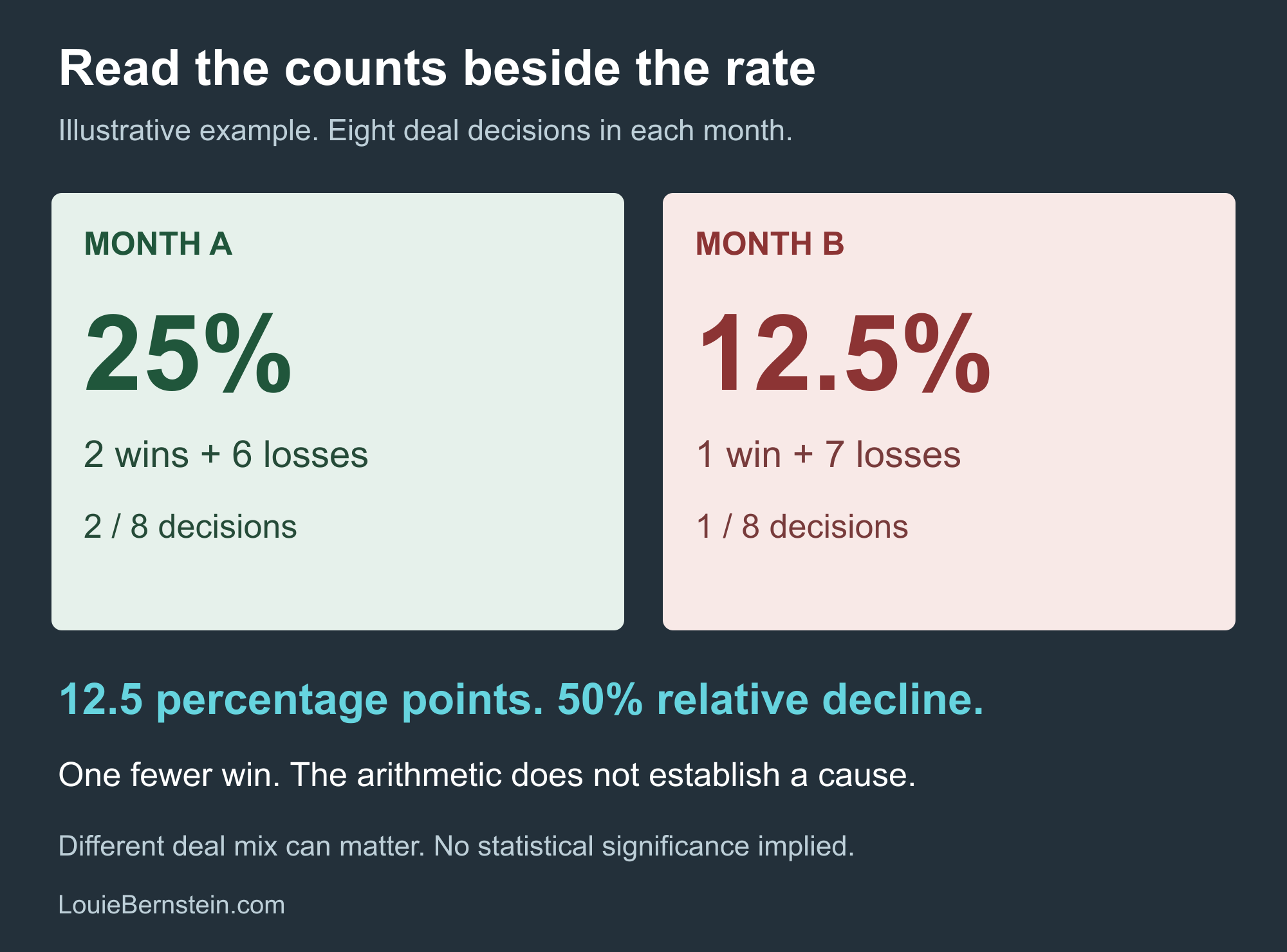
- In an illustrative example, two wins from eight deal decisions is 25%; one win from eight is 12.5%. One fewer win creates a 50% relative decline without explaining its cause.
- Before cutting, hiring, or entering another market, name the problem that action would solve and the evidence that supports it.
- Run a limited test with an owner, a spending limit, a review date, and conditions for continuing or stopping.
You miss the month. By Monday, the company has a new strategy.
More outbound. Fewer expenses. A new salesperson. Bigger customers. Smaller customers. Everybody has an answer, and the founder wants a move that feels decisive.
For a $1M to $10M ARR B2B business, each move can change months of work. Before you send the team in another direction, find out what the miss actually tells you.
A revenue shortfall tells you what happened. You still have to establish why it happened.
When does a bad month require immediate action?
Act immediately when verified evidence shows an obligation or customer commitment is at risk, regardless of whether the broader strategy is sound. Confirm the amount, deadline, and available options with the right owner. Handle the immediate exposure while keeping the longer-term decision separate from the emotion of missing a sales target.
Check the obligations before debating the strategy
If cash available won't cover a dated payment, ask finance to verify the gap and feasible responses. If a customer deliverable is at risk, have the delivery owner confirm what can be done. Don't wait for a full sales cycle to address an obligation coming due next week.
Equally, don't treat a bookings miss as proof that a payment will fail. Revenue, bookings, collections, and available cash answer different questions. Make sure the number driving the urgency measures the problem you're trying to solve.
Keep a temporary response temporary
A short spending pause can buy time to verify a plan. It doesn't automatically mean the market is wrong or that the sales team is too large. State the reason, scope, approver, and review date for the temporary action.
Tell people what changes in their work. The previous installment, telling your team the business is struggling, explains how to communicate checked facts without promising a result you can't control.
How do I tell a timing problem from a sales problem?
Separate timing from a sales problem by inspecting the opportunities behind the miss: buyer-confirmed dates, completed decisions, losses, new qualified pipeline, and work that failed to happen. Compare similar customers and deal types over periods that fit your selling cycle. Don't accept a moved close date as proof that the revenue is merely delayed.
Start with the deals that explain the gap
Ask which opportunities were expected, what buyer action supported the expectation, and what changed. A buyer-confirmed procurement delay needs a different response from an opportunity that never had approved budget.
Review wins as well as losses. Did successful buyers still have the same problem, pay an acceptable price, and move through the process? Did the lost deals fail for a shared reason, or are unrelated outcomes being grouped into a single story?
Use a win/loss analysis with buyer evidence when you need the reason behind a decision. This article is about what you should do with the finding before changing direction.
Read the counts beside the percentages
Here's an illustrative example. In one month, the team records two wins and six losses: two divided by eight is a 25% closed-decision win rate. In the next month, one win and seven losses gives you 12.5%.
The rate fell 12.5 percentage points, or 50% relative to the earlier rate. The difference is one fewer win from the same number of decisions. That's worth examining. It doesn't establish that the market stopped buying or that a rep forgot how to sell.
The two months aren't matched groups of opportunities. Check buyer mix, deal size, seller involvement, and how long the deals had been open. These are invented counts for explaining the arithmetic, not a client result or a claim of statistical significance.
Look at what was created before the month ended
A closed deal may reflect work started months earlier. Check whether new qualified opportunities, buyer participation, and agreed next steps are holding up. A weak month of prospecting may create a later problem even while current bookings look healthy.
Choose comparison periods from the sales process, seasonality, and the decisions you need to make. Three calendar months isn't a universal waiting rule. One confirmed change, such as a major buyer segment losing its budget, can justify an immediate review.
What evidence should I demand before cutting, hiring, or changing markets?
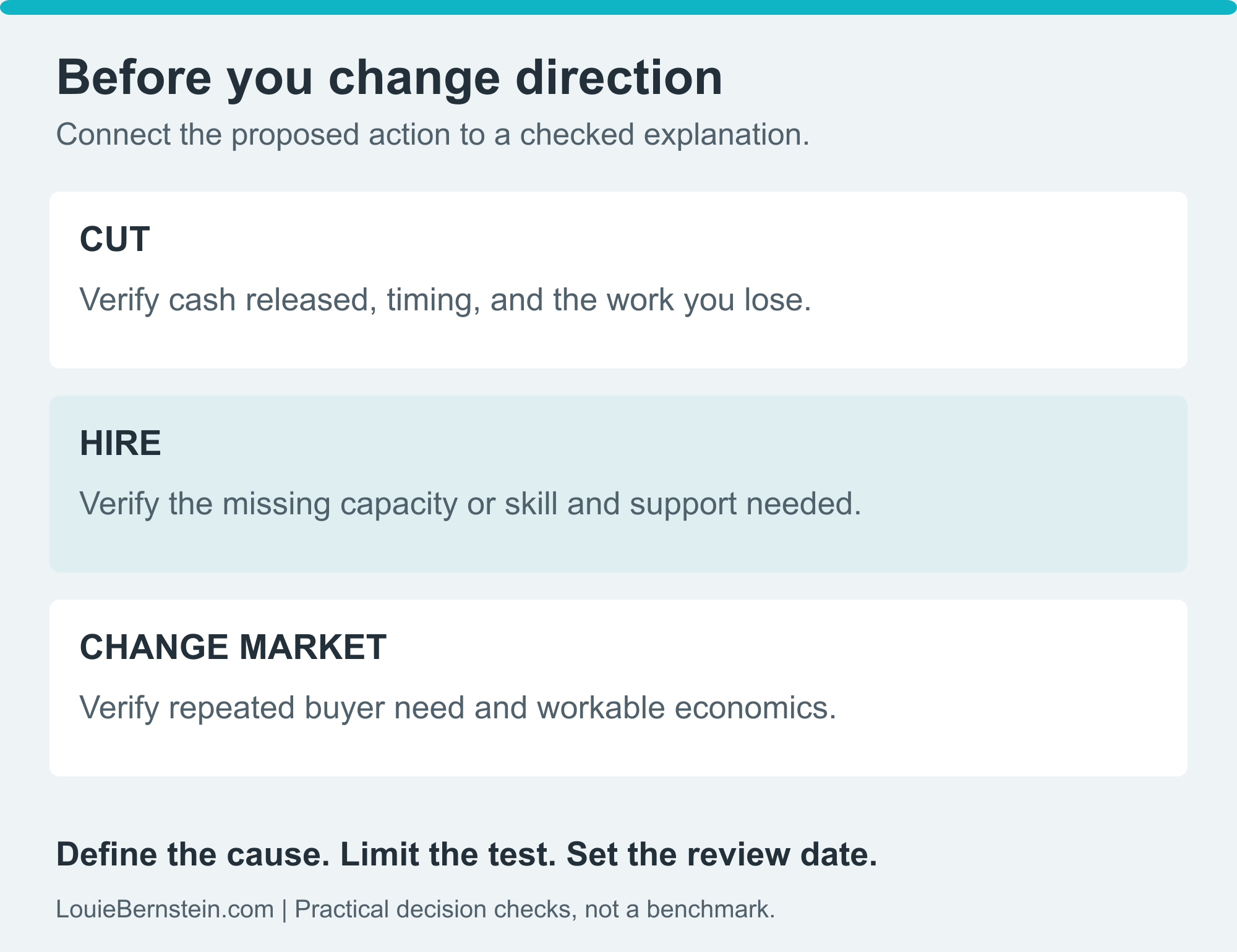
Demand evidence that connects the proposed action to the diagnosed problem and shows its likely cost, timing, and consequences. A cut should remove a cost you can do without; a hire should address a defined capacity or skill gap; a new market should show buyer need and workable economics beyond one encouraging conversation.
Before cutting, identify what the expense supports
Write down the spending you propose to stop, what cash it would actually release and when, and which customer or selling work depends on it. Include commitments, transition costs, and the effort needed to restart the activity.
A tool nobody uses and an employee supporting renewals aren't interchangeable line items. Review the decision with finance and the operating owner. A percentage reduction applied to every budget doesn't tell you what capability the business loses.
Before hiring, name the work that isn't getting done
Is qualified demand going unanswered because current reps lack time? Is a technical skill missing? Or do reps lack a repeatable process, clear accountabilities, and coaching? A new hire solves only some of those problems.
Define the role, required support, ramp assumptions, and affordability. Examine what the existing team could accomplish if you removed the actual bottleneck. Don't make “another salesperson” the explanation for a problem you haven't located.
Before changing markets, test the new buyer's reason to act
A large prospect asking for a custom feature can look like a new market. Find out whether other comparable buyers share the problem, have a way to pay, and can buy on terms you can deliver profitably.
Estimate selling time, product changes, delivery load, and the cost of leaving current customers underserved. Keep the exploration separate from abandoning your existing segment. A promising conversation is evidence to investigate, not a completed market-entry decision.
How can I test a change without disrupting the whole business?
Test a change by stating the explanation you want to examine, choosing a limited scope, and writing the evidence that would support or weaken it before the test begins. Give the work an owner, resource limit, and review date. Keep other major changes stable enough that you can interpret what happened.
Write the claim before choosing the fix
“Sales are down” is an observation. “We're losing qualified buyers because they can't get implementation help in the required window” is an explanation you can check.
For that explanation, review buyer feedback and delivery availability. Test an approved later start or a useful smaller phase with a defined set of suitable opportunities. Record acceptance, actual delivery effort, and the objections that remain.
If you're changing the offer, the price, the buyer, and the outreach at once, you may get a result without knowing which change mattered. In a small B2B business you won't always isolate every factor. Be honest about that limit instead of calling every improvement proof.
Use research as support for the method
A 2024 study by Camuffo and colleagues analyzed 759 firms across four randomized trials conducted in Italy and the UK from 2016 to 2019. Training entrepreneurs to reason through testable explanations increased idea termination and changed the pattern of major strategy changes.
The study supports disciplined testing, not a guaranteed result for your company or a fixed number of months to wait. It also doesn't say to hold every strategy forever. A good test can give you a reason to stop pursuing an idea.
Set the boundary before the result arrives
Specify what you'll measure, how you'll select opportunities, what a useful result looks like, and what would make you stop early. Set the review date from the work required to observe the result, within the resources you can afford to commit.
If the business has no consistent sales process or reliable records, start by checking a defined group of deals and documenting the next steps. A small, honest review is more useful than a dashboard that hides the missing evidence.
How do I know when to stay the course and when to change strategy?
Stay with the strategy when the core buyer need and economics still hold and the miss has a credible, addressable explanation. Change direction when reliable evidence undermines an important assumption and the alternative has enough support to justify its cost. In either case, record the decision, its limits, and the next review trigger.
What I check before blaming the market
I've written about a salesperson with the biggest pipeline and the fewest closed deals. When I examined the opportunities, the buyer was saying one thing and the rep was hearing something more optimistic. The pipeline problem was hidden in the interpretation of buyer statements.
Before I recommended a larger change, I'd want to know whether the same thing is happening in the deals behind the bad month. Were we losing good opportunities, or counting conversations as commitments? You can't make a sound strategic decision from a pipeline built on guesses.
That lesson from my sales work matters at founder level. If the evidence was wrong, correct how the team qualifies and records deals. Don't automatically change the market to make an inaccurate forecast look like a strategic discovery.
Make a decision the team can follow
Write whether you're holding the strategy, making a tactical correction, or testing a different direction. Name what changes, what stays in place during the test, who owns the work, and what evidence will reopen the decision.
A Fractional Sales Leader can inspect deal evidence, identify gaps in process and coaching, and help turn a sales concern into a measured operating response. The founder still owns the strategy, with finance and delivery involved where the decision affects them.
At your next review, ask: “What changed in the evidence, and what decision does that justify?” Make sure the answer is more specific than “we had a bad month.”
- Which business worries should you act on first?
- Keep selling when delivery is full
- Protect work that depends on one employee
- Tell your team when business is struggling
- Stop one bad month from changing your strategy
Frequently Asked Questions
Should I wait for three bad months before making a change?
No fixed number of months fits every B2B company. Use the sales cycle, available evidence, and time left to act. Address a confirmed urgent risk now. For a strategic change, identify which assumption failed and what supports the alternative.
What if my team thinks reviewing the evidence means I'm avoiding a decision?
Give the review an owner, a deadline, and a specific decision to make. Explain the actions you're taking immediately and the evidence still needed for the larger choice. An open-ended request for more analysis is harder to distinguish from avoidance.
Should I lower the sales target after a bad month?
Review whether the target's assumptions still hold before changing it. Keep the actual result visible and separate the operating forecast from the performance expectation. Don't revise the target solely to make the miss disappear, or leave an unsupported target untouched to prove resolve.
Can I use industry benchmarks to decide whether my strategy is broken?
Use benchmarks as context after checking the population, period, and calculation. Your buyer mix, offer, sales cycle, and margins may differ. A gap from an industry average can suggest a question to investigate; it doesn't identify the cause by itself.
What if a test doesn't give me a clear answer?
Record what remains uncertain and decide whether another test is worth the time and cost. You may need more comparable opportunities or a better-defined explanation. If waiting would remove important options, make the best supported decision and state the uncertainty honestly.
Check the evidence before you redirect the team.
If you're a $1M to $10M ARR B2B founder and a sales miss has you considering a bigger change, let's inspect the pipeline, process, and accountabilities behind it. Learn about Fractional Sales Leadership at LouieBernstein.com.
Schedule a 30-Minute CallAbout the Author

Louie Bernstein Fractional Sales Leadership
Louie Bernstein is a Fractional Sales Leader with 50 years of sales experience and has worked as a Fractional Sales Leader since 2017. He built and ran MindIQ for 22 years. He helps B2B founders at $1M to $10M ARR build repeatable sales systems so selling doesn't depend on the founder.