Your sales process lives in your head, and that's your biggest risk
Every founder needs a written sales playbook because the company's most valuable sales asset, how the founder sells, usually exists only in the founder's head. That's a risk every time you take time off, hire a rep, lose a sales leader or try to sell the company. Start with eight short pages. A written playbook lets the company keep growing when you're not in the room.
Key Takeaways
- A founder's sales process is the company's most valuable sales asset, and in most $1M to $10M companies it isn't in the CRM or anywhere else. It's in the founder's head.
- An unwritten sales process becomes a business risk at four moments: when the founder is away, when a rep is hired, when a sales leader leaves, and when the company is sold.
- The average new rep takes 6.2 months to ramp (Bridge Group, 2026), and the average VP of Sales stays about 2.0 years (Pave data on 14,000 executives, via SaaStr). Knowledge that isn't written down leaves with people.
- A starter Sales Playbook can be eight pages: best-fit customer, reason to reach out, discovery questions, stages, objections, pricing rules, proof and targets.
- This week, write one page: the answer to the question your reps ask you most often. Then add a page every time a rep asks you something twice.
The most valuable sales asset in your company isn't in your CRM.
It's in your head.
That should scare you a little.
I've been selling for almost 50 years. The founders I meet who are stuck at $3M almost always have the same thing in common. Brilliant at selling. Nothing written down.
If you had to hand your sales process to someone tomorrow, how many pages would it be?
Why does every founder need a written sales playbook?
Every founder needs a written sales playbook because a sales process that lives only in the founder's head can't be taught, checked or handed off. A written playbook turns how you sell into something a rep can follow, a manager can coach to, and a buyer of your company can see. Without it, growth depends on your calendar.
What a Sales Playbook is
A Sales Playbook is the written version of how your company sells. Who you sell to. Why they should talk to you. What you ask, what you say, and what you do when a buyer pushes back. It's the document that lets a good salesperson sell your product without calling you every afternoon.
Why founders don't write one
Writing down how you sell is one of the least glamorous things a founder can do. Closing a deal feels like progress. Writing a page about how you close feels like homework. So founders keep closing, and the playbook never gets written. I understand it. I did the same thing for years.
What's the risk of keeping the sales process in your head?
The risk of keeping the sales process in your head is that every important moment in the company runs through one person's memory. When you're away, deals wait. When you hire, reps guess. When a sales leader leaves, what they learned leaves too. When you sell the company, buyers see a business that depends on you.
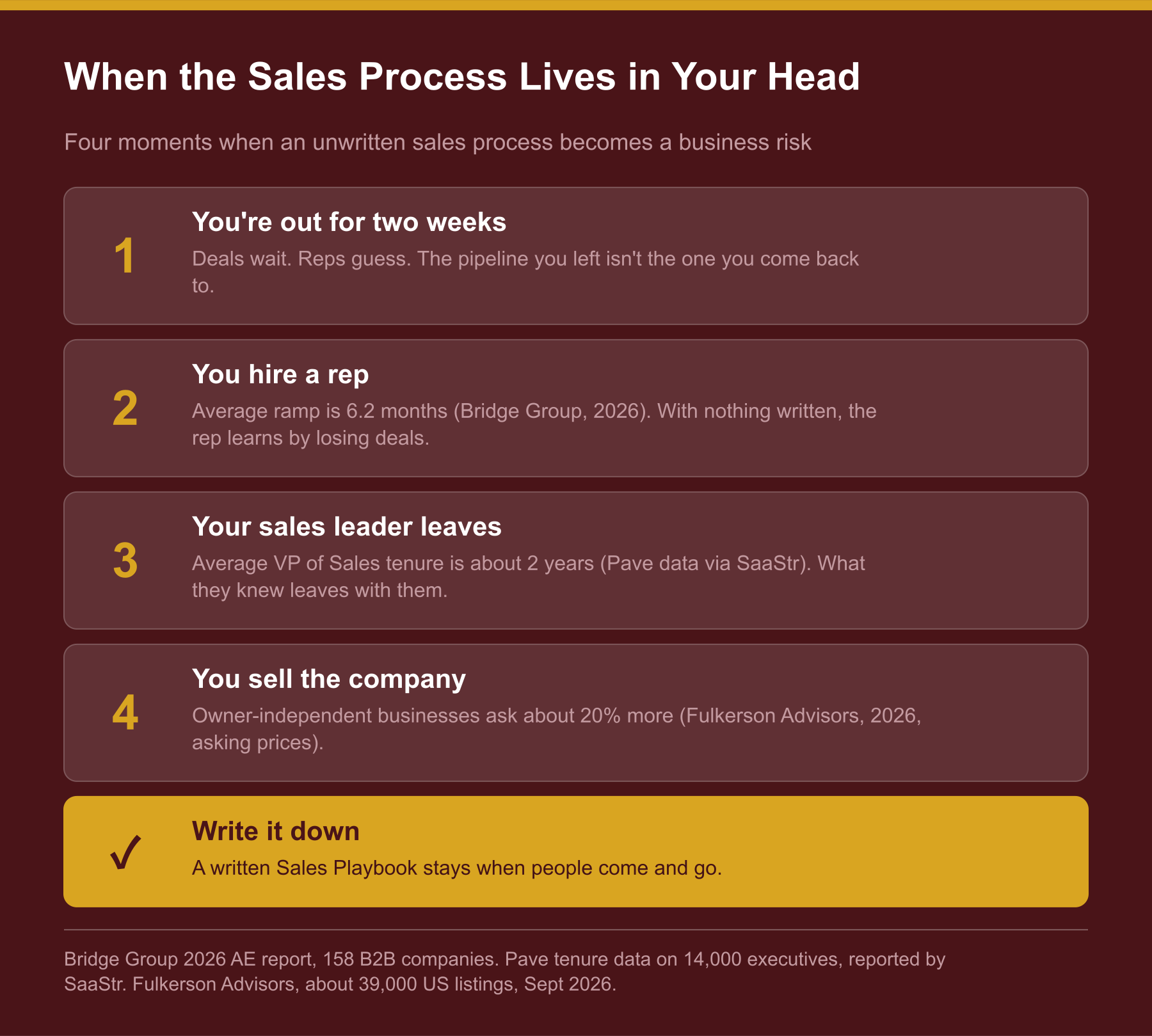
People come and go. Pages stay.
The 2026 Bridge Group report on 158 B2B companies puts average rep ramp at 6.2 months, the longest in the study's history. Pave's data on 14,000 executives, reported by SaaStr, puts average VP of Sales tenure at about 2.0 years. Put those together. A sales leader may spend a quarter of their tenure just getting up to speed. If what they learn isn't written down, the next one starts from zero too.
Your CRM doesn't hold it either
Founders sometimes tell me the process is "in the CRM." A CRM holds deals. It doesn't hold why you walked away from the one in March, or what you say when a buyer asks for a discount. And CRM data itself is shaky in most companies. In Validity's 2022 survey of CRM administrators, 44% estimated their company loses more than 10% of annual revenue to poor CRM data.
Buyers of your company notice
Fulkerson Advisors studied about 39,000 US business-for-sale listings in 2026. Businesses described as running without the owner had a median asking price of 2.8 times cash flow, against 2.4 times for the rest, about 20% higher. Those are asking prices, not sale prices. I've covered the valuation side in whether a documented sales process raises your valuation.
How many pages should a founder's sales playbook be?
A founder's first sales playbook can be eight pages, one for each thing a rep needs to sell without you. Short is better than complete. A rep will read eight pages. Nobody reads a binder. Start with eight, then add a page every time a rep asks you the same question twice.
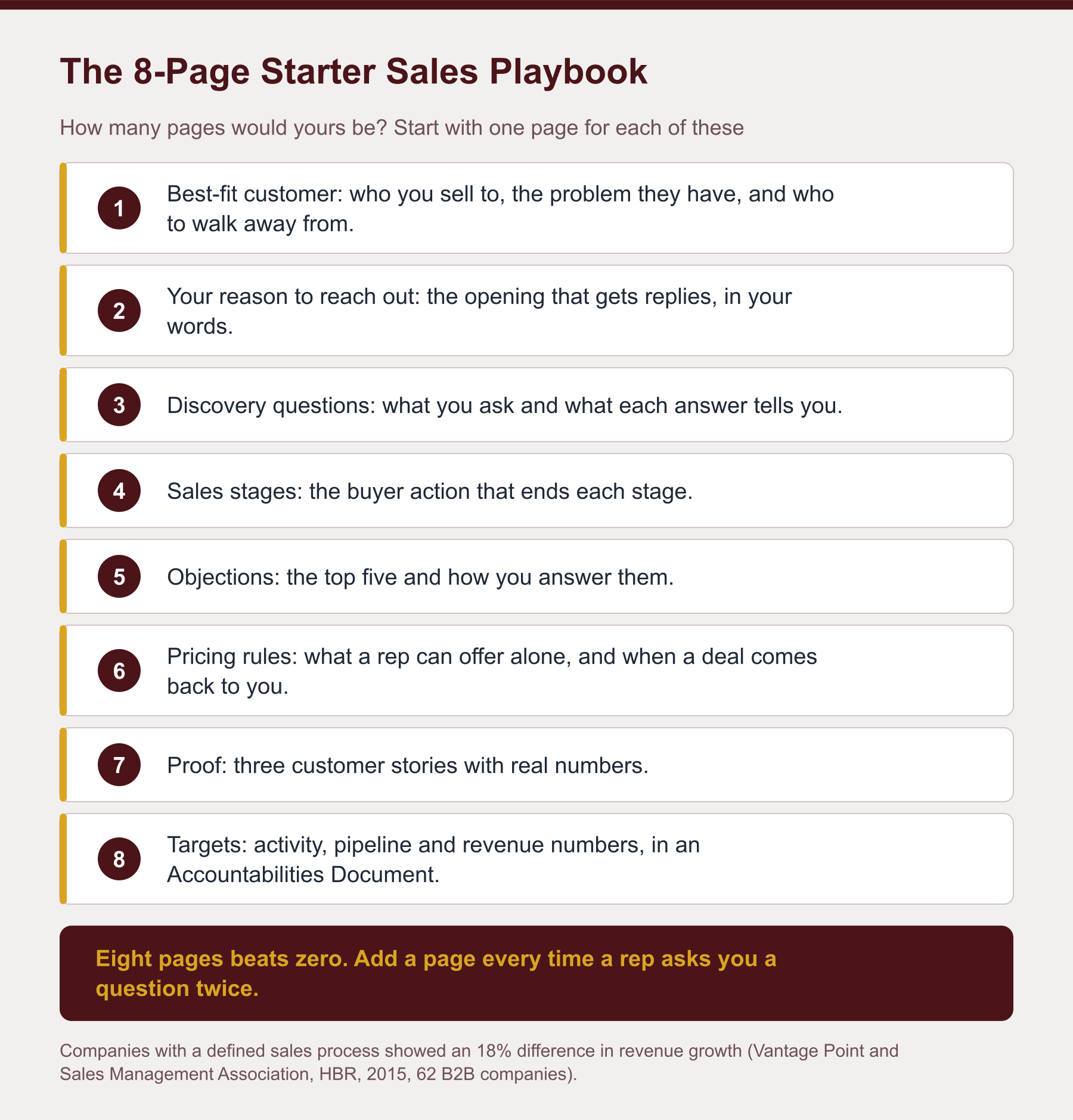
The eight pages
- Best-fit customer. Industry, size, the problem they have, and the signs that tell you to walk away.
- Your reason to reach out. The opening that gets replies, written the way you'd say it.
- Discovery questions. What you ask and what each answer tells you.
- Sales stages. The buyer action that ends each stage, like "buyer confirmed budget and a decision date."
- Objections. The five you hear most, with your answers.
- Pricing rules. What a rep can offer alone, the discount limit, and when a deal comes back to you.
- Proof. Three customer stories with real numbers.
- Targets. Activity, pipeline and revenue numbers for each seller, in an Accountabilities Document.
Does a written process pay off?
In 2015, Vantage Point Performance and the Sales Management Association studied 62 B2B companies and published the results in Harvard Business Review. Companies with a defined, formal sales process showed an 18% difference in revenue growth over companies without one. The companies were mostly larger than yours. I think the difference matters more in a small company, where there's no layer of managers to cover for what isn't written down.
What did writing 558 pages teach me about getting it out of my head?
Writing a 558-page sales training course taught me that most of what a founder knows about selling has never been said out loud. I'd carried that course in my head for 30 years. Getting it onto paper took real work. It also made it something other people could use without me.
How it happened
In 2008, after about 20 years of running MindIQ, I hit the wall. I was diagnosed with job burnout and depression. When I went looking for answers, the first thing I did was write down the sales training course that had been in my head for 30 years. How to prospect. How to handle objections. How to close. All 558 pages of it.
You don't need 558 pages. But writing them taught me something. When you write down how you sell, you find out how much you do without thinking about it. That's the point. If you can't explain it on paper, you can't teach it to a rep either.
The most underrated act of leadership
I believe writing down how you sell is the most underrated act of leadership in a small company. It doesn't feel like leading. It feels like paperwork. But it's the thing that lets your company keep growing when you're not in the room. It's how you stop being the reason your sales reps keep failing.
How do you start writing your sales playbook this week?
Start your sales playbook this week by writing one page: the answer to the question your reps or team ask you most often. Then pull your last 10 won deals and write down the steps they all shared. Those two pages are a real start, and they're built from what already works.
Four rules that keep it useful
- Write from real deals. Describe what closed deals, not what you wish happened.
- Use your own words. The phrases that work on buyers belong in the playbook exactly as you say them.
- One page per topic. Short pages get read and updated. Long ones get ignored.
- Hand it to someone and watch. Every time they get stuck, you've found a missing page.
When to get help
Many founders know they need a written playbook and still never find the hours to write it. Getting it out of the founder's head is where I start as a Fractional Sales Leader. I work in 12-week engagements, 20 to 35 hours a week, at $14K a month. Other Fractional Sales Leaders run $10K to $20K a month. A full-time VP of Sales costs $250K to $400K a year, and the first thing a good one asks for is the playbook you haven't written.
Frequently Asked Questions
When should a founder write a sales playbook?
Before the first sales hire. A rep hired into a company with a written playbook has something to follow. A rep hired without one has to guess. If you already have reps, write it now, starting with the questions they ask you most.
How long does it take to write a sales playbook?
A first draft of eight short pages takes days, not months, if you write from deals you've already won. The playbook is never finished. Plan to update it every time a rep gets stuck, and review it once a quarter.
Is a sales playbook the same as a sales script?
No. A script tells a rep what to say word for word. A Sales Playbook explains who to sell to, what to ask, why it works, and what to do when a buyer pushes back. Reps bring their own voice. The playbook gives them the knowledge.
Can AI write my sales playbook for me?
AI can help you organize and clean up what you write. It can't know why you walked away from a deal or what you say when a buyer pushes on price. That knowledge is in your head. Get it out first, then use AI to tidy it.
What if my sales process changes every few months?
Then a written playbook matters even more. Write what works now and date it. When something changes, update the page. A playbook that changes with you is still better than a process that only exists in your head.
Get your sales process onto paper.
If you're a $1M to $10M ARR B2B founder and your sales process still lives in your head, let's talk about what the first eight pages should say. Learn about Fractional Sales Leadership at LouieBernstein.com.
Schedule a 30-Minute CallAbout the Author

Louie Bernstein Fractional Sales Leadership
Louie Bernstein is a Fractional Sales Leader with 50 years of sales experience and has worked as a Fractional Sales Leader since 2017. He built and ran MindIQ for 22 years. He helps B2B founders at $1M to $10M ARR build repeatable sales systems so selling doesn't depend on the founder.