What Should You Be Able to Measure in 12 Weeks, Before Revenue Moves?
You know a Fractional Sales Leader is working when five numbers move inside 12 weeks, before revenue does. Founder selling hours go down. The forecast lands closer to the actual. More open deals carry a dated buyer next step. Every rep works from a signed Accountabilities Document. Deals start closing with no founder on the call. Write down all five on day one, because without a starting number you have nothing to compare.
Key Takeaways
- A Fractional Sales Leader is working when five numbers move within 12 weeks: founder selling hours, forecast accuracy, dated buyer next steps, signed Accountabilities Documents, and deals closed without the founder.
- Revenue is the wrong first test. Average rep ramp is 6.2 months (Bridge Group, 2026), so revenue in the first 12 weeks mostly reflects deals that started before the Fractional Sales Leader arrived.
- 4 in 5 sales and finance leaders missed a quarterly forecast in the past year (Xactly, 2024). A forecast that gets closer to the actual each month is one of the earliest signs the sales system is improving.
- On day one, write down the starting number for each of the five. A Fractional Sales Leader who doesn't ask for a baseline can't prove anything changed.
- Judge reports by buyer actions, such as a meeting booked or a budget confirmed. Calls made and emails sent are rep activity and prove nothing about the pipeline.
- At week 12, count how many of the five numbers moved. Four or five: renew. Two or three: ask why and fix the plan. Zero or one: stop.
Most founders judge a Fractional Sales Leader by revenue. I think that's a mistake, and I say that as the guy being judged.
Revenue matters. It's why you hired help. But revenue is the last number to move, and if it's the only one you watch, you'll spend three months guessing.
If you're a founder at $1M to $10M ARR and still closing most of the deals, you need a way to check the work in weeks. Here's how I'd check it.
Revenue is the last number to move. Don't make it the first one you check.
Why can't revenue tell you if a Fractional Sales Leader is working in the first 12 weeks?
Revenue can't tell you if a Fractional Sales Leader is working in the first 12 weeks because the deals closing in those weeks started before the engagement did. Revenue reports what your sales effort looked like one sales cycle ago. A founder who judges by early revenue is grading the old system.
Revenue runs one sales cycle behind
Say your sales cycle is 90 days. A deal that closes in week 8 came into your pipeline before the Fractional Sales Leader started. The Fractional Sales Leader may have helped it across the line. The pipeline it came from was yours.
New reps make the lag longer. The 2026 Bridge Group report on 158 B2B companies puts average ramp to full productivity at 6.2 months, the highest in the study's history. Only 48% of reps hit quota. If part of the engagement is hiring or retraining reps, the revenue from that work shows up well after week 12.
Early revenue can fool you in both directions
A big deal you were already working can close in month two and make a weak engagement look good. A slow month can make a strong engagement look bad while the pipeline underneath is getting cleaner every week. Neither result tells you whether the sales system is improving.
So for the first 12 weeks, watch the numbers that move first. I've written about what happens in the first 90 days with a Fractional Sales Leader. This article is about how you check it.
What five numbers should move before revenue does?
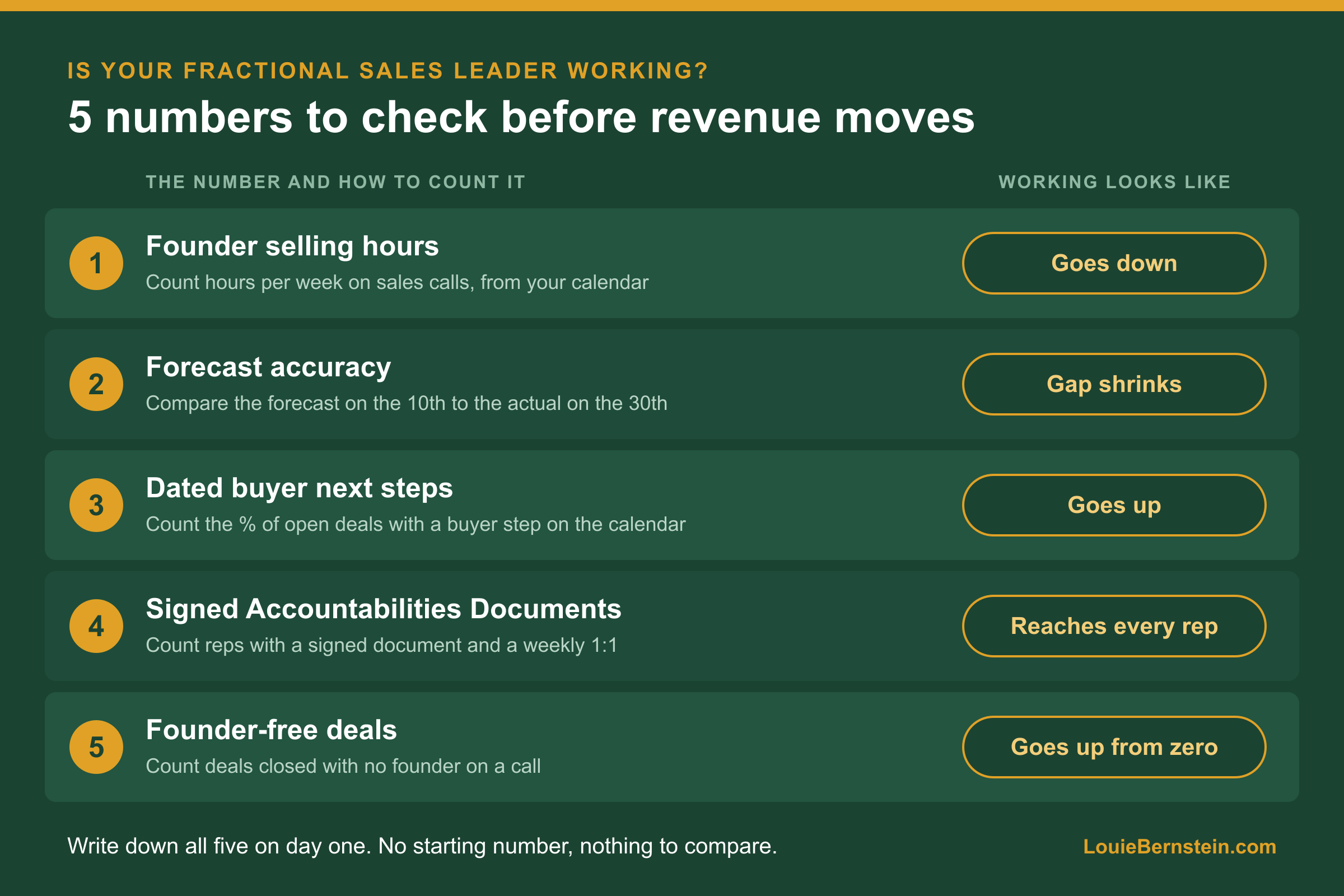
Five numbers should move before revenue does when a Fractional Sales Leader is working: founder selling hours, forecast accuracy, the share of open deals with a dated buyer next step, the number of reps with a signed Accountabilities Document, and deals closed without the founder. Each one can be counted in under an hour from your calendar and your CRM.
1. Founder selling hours
Open your calendar and count the hours you spent on sales calls last week: first calls, demos, follow-ups, negotiations. That's your starting number. Count again every two weeks. If a Fractional Sales Leader is working, the number goes down and the calls you keep are the ones that need a founder.
2. Forecast accuracy
On the 10th of the month, write down what you expect to close by the 30th. On the 30th, write the actual next to it. The gap between the two is your forecast accuracy.
Most companies are bad at this. In a 2024 Xactly survey of 405 sales and finance professionals, 4 in 5 said they'd missed a quarterly forecast in the past year, and 52% of sales leaders said their forecasts are off by 10% or more. An older Gartner survey found only 45% of sales leaders and sellers had high confidence in their forecast (Gartner, 2020). You don't need a perfect forecast in 12 weeks. You need the gap to shrink each month. I go deeper on the cause in why founders can't forecast.
3. Open deals with a dated buyer next step
Pull every open deal. Count the ones where the buyer has agreed to a next step with a date on it: a meeting on the calendar, a decision date, a contract review. Divide by the total. A deal with no dated buyer step is a hope, and I call a pipeline full of them hope-ium.
This number should climb fast. Some of the climb comes from reps booking real next steps. Some comes from dead deals being removed. Both count.
4. Reps with a signed Accountabilities Document
An Accountabilities Document puts in writing what a rep owns, what gets measured, and how often it's reviewed. Count the reps who've signed one and who get a weekly 1:1 against it. By the middle of the engagement the answer should be all of them. I've explained how the document works in how an Accountabilities Document spots underperformance early.
5. Deals closed without the founder
Count the deals that closed last quarter with no founder on any call. For most founders I meet, the starting number is zero. In a 12-week engagement you may only see one or two. One is enough to prove a rep can win from the written process. If your sales cycle is longer than 12 weeks, count deals that reached the proposal stage without you.
When should each number move during a 12-week engagement?
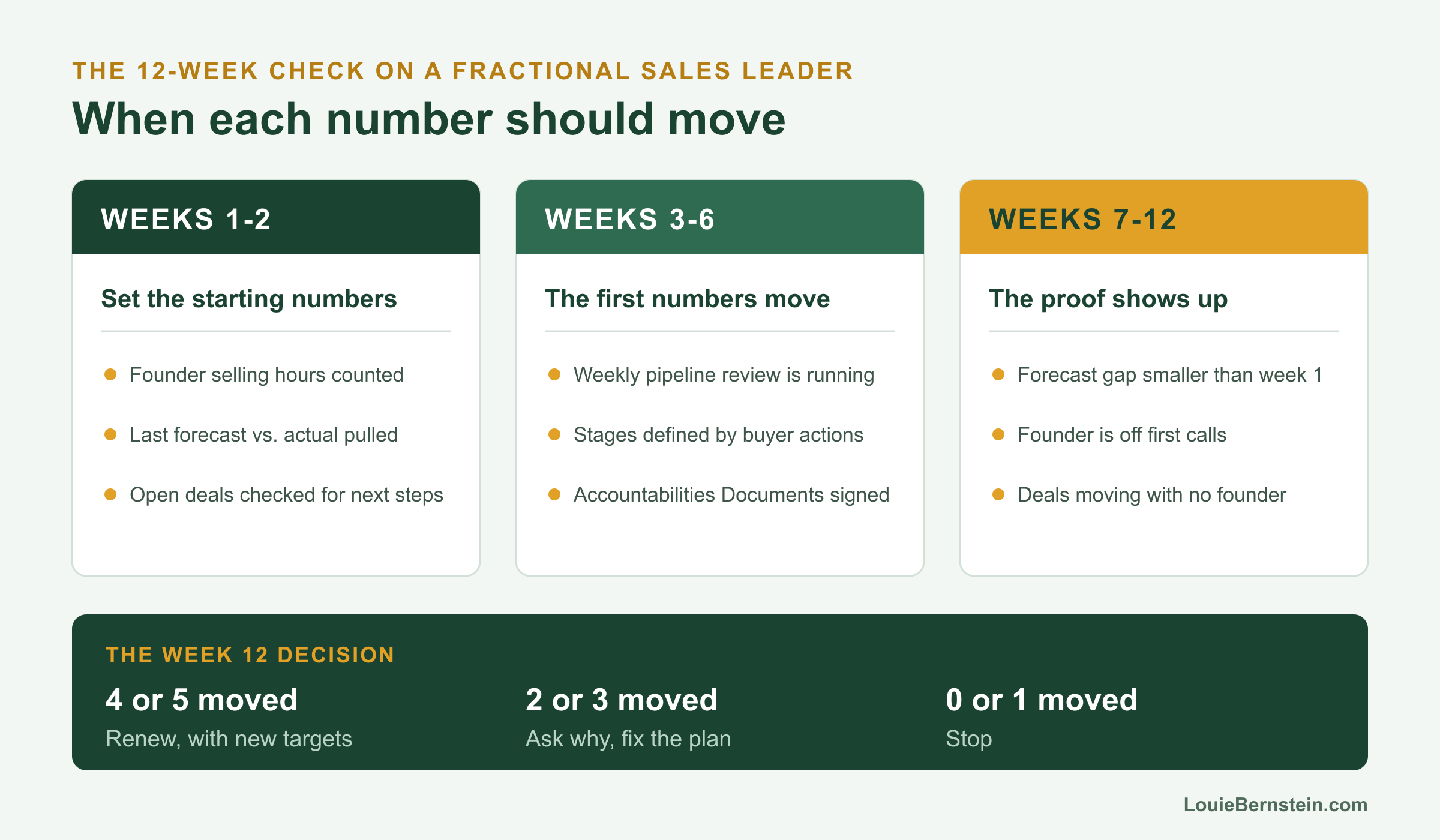
During a 12-week engagement with a Fractional Sales Leader, the starting numbers get written down in weeks 1 and 2, the pipeline and accountability numbers move in weeks 3 through 6, and the forecast and founder-hours numbers show proof in weeks 7 through 12. A number that hasn't moved by its window deserves a direct question.
Weeks 1 and 2: set the starting numbers
All five numbers get counted and written down. This takes a few hours and it's the step most engagements skip. If nobody records where you started, week 12 turns into an argument about how things feel.
Weeks 3 through 6: the first numbers move
The weekly pipeline review starts and doesn't get cancelled. Stages get defined by what the buyer has done, which I cover in why pipeline stages need exit criteria. Accountabilities Documents get signed. The share of deals with a dated next step should already be climbing, because cleaning a pipeline is fast work.
Weeks 7 through 12: the proof shows up
By now you've had two or three month-ends to compare the forecast to the actual. The gap should be smaller than it was in week 1. You should be off first calls if you have reps to take them. And at least a few deals should be moving forward with no founder in the room.
What are the signs a Fractional Sales Leader isn't working?
The clearest signs a Fractional Sales Leader isn't working are no starting numbers, weekly reports full of activity instead of buyer actions, and nothing in writing by week 6. A Fractional Sales Leader who becomes your new best closer is also a warning sign, because the company now depends on a different person.
What I see when I audit sales teams
When I start with a new client, I ask for two things: last month's forecast and last month's actual. Most founders can hand me the actual in a minute. Very few can hand me the forecast, because nobody wrote one down. The number lived in the founder's head, and it changed every time a deal slipped.
I ran MindIQ for 22 years and I was my own best salesperson for a long stretch of it. I know how easy it is to believe your own pipeline. So here's my rule: if a claim about your sales team can't be checked against something written down, treat it as a feeling.
If a claim about your sales team can't be checked against something written down, treat it as a feeling.
Five warning signs
- No baseline. Nobody counted the five numbers in the first two weeks.
- Activity reports. The weekly update lists calls made and emails sent. It says nothing about what buyers did.
- Nothing in writing. By week 6 there's no Sales Playbook draft, no stage definitions, and no signed Accountabilities Documents.
- A new hero. The Fractional Sales Leader is closing the deals personally. Revenue may be up. You've just traded one person the company depends on for another.
- A forecast nobody will sign. If the Fractional Sales Leader won't put a number in writing on the 10th, the pipeline behind it isn't trusted yet.
One warning sign calls for a conversation. Three calls for a decision.
What should you do at week 12: renew, change the plan, or stop?
At week 12, count how many of the five numbers moved against the starting numbers and decide from the count. If four or five moved, renew the Fractional Sales Leader with new targets. If two or three moved, find out why and change the plan. If zero or one moved, stop the engagement.
Four or five moved: renew with new targets
The system is taking hold. Set the next 12 weeks around the numbers that revenue follows: stage-to-stage conversion, days in each stage, and deals closed without you. My engagements run 12 weeks and are renewable. Most clients renew for 6 to 12 months in total, which is about how long it takes for the early numbers to turn into revenue you can count on.
Two or three moved: ask why
Find out which side the gap is on. Sometimes the Fractional Sales Leader missed. Sometimes the founder never let go of the calls, skipped the pipeline reviews, or wouldn't replace a rep everyone knew was failing. Sometimes the founder is the reason a number didn't move. Be ready to hear it.
Zero or one moved: stop
Other fractional sales leaders charge $10K to $20K a month, and my fee is $14K a month. Twelve weeks at $14K is about $42,000. That's enough money and enough time to see movement. If nothing you can count has changed, more time won't fix it.
A full-time VP of Sales costs $250K to $400K a year, and you usually wait much longer than 12 weeks to find out if that hire is working. A short clock and a written scorecard are the best protection a founder has.
Frequently Asked Questions
How long does it take to see results from a Fractional Sales Leader?
You should see results you can count within 12 weeks of hiring a Fractional Sales Leader: fewer founder selling hours, a cleaner pipeline, and a forecast closer to the actual. Revenue usually takes at least one full sales cycle longer, because new deals have to work their way through the pipeline.
What if revenue goes up but the five numbers don't move?
If revenue goes up while the five numbers stay flat, the sales system hasn't changed. The lift most likely came from deals already in the pipeline or from someone closing personally. Enjoy the quarter, then ask what's different in writing. If the answer is nothing, the lift won't repeat.
What should a Fractional Sales Leader report to me each week?
A Fractional Sales Leader should give the founder a one-page weekly report: the five numbers against their starting values, the deals that moved a stage and the buyer action that moved them, the deals removed from the pipeline, and what's being built or fixed next week. If the report takes more than ten minutes to read, it's too long.
Can I measure a Fractional Sales Leader if I don't have salespeople yet?
Yes. With no salespeople, three of the five numbers still apply to the founder's own deals: founder selling hours, forecast accuracy, and dated buyer next steps. Replace the other two with written work you can inspect, such as the Sales Playbook draft, the hiring scorecard, and the Accountabilities Document your first rep will sign. I cover that situation in why hire a Fractional Sales Leader with no salespeople.
Should I measure a full-time VP of Sales the same way?
Yes. The same five numbers work for a full-time VP of Sales, and most founders never ask for them. The difference is the clock. A Fractional Sales Leader gets checked at 12 weeks. Founders often give a full-time VP a year before asking hard questions, and by then the hire has cost $250K or more.
Want to know your five starting numbers?
If you're a $1M to $10M ARR B2B founder and you're still closing most of the deals, let's count where you are today. Learn about Fractional Sales Leadership at LouieBernstein.com.
Schedule a 30-Minute CallAbout the Author

Louie Bernstein Fractional Sales Leadership
Louie Bernstein is a Fractional Sales Leader with 50 years of sales experience and has worked as a Fractional Sales Leader since 2017. He built and ran MindIQ for 22 years. He helps B2B founders at $1M to $10M ARR build repeatable sales systems so selling doesn't depend on the founder.