Start with the number you need, work back through your real conversion rates, and the leak shows itself.
To build a reverse funnel, start with your new-revenue goal for the year and divide it by your average deal size to get the number of deals you need. Then divide by each stage's real conversion rate, one stage at a time, working backward to first conversations per week. Use your own CRM history, not industry averages. The stage whose rate fell furthest below your best quarter is where revenue is leaking.
Key Takeaways
- A reverse funnel turns an annual revenue goal into the number of first conversations needed each week, by dividing the goal by average deal size and then by each stage's conversion rate, working backward.
- Pull conversion rates from the last 2 to 4 quarters of your own CRM data, by stage. If your stages have no exit criteria, fix that first, because the rates won't mean anything.
- The leak is the stage whose conversion rate dropped furthest below your own best quarter. Fix that stage before you buy more leads.
- Slow deals leak revenue: across 655,000 B2B opportunities, win rates fell from 18% for deals that slipped a week to 3% for deals that slipped more than six months (Ebsta and Pavilion, 2025).
- Rerun the reverse funnel monthly in your pipeline review, and every time the goal, the average deal size or the team changes.
Most founders set the revenue goal and then hope. They know the number they need. They don't know how many conversations it takes to get there this week.
A reverse funnel fixes that in an afternoon. One page. Five divisions. And when you do it with your own numbers, something useful falls out of the math: the one stage where your revenue is leaking.
Chief Outsiders wrote in April 2026 that most growth-stage companies are leaving 15% to 25% of achievable revenue on the table through pipeline leaks. That's their estimate, and the post doesn't cite a study behind it. I don't need their number to agree with the point. In my experience there's almost always a leak. The question is where.
Your revenue goal isn't a target. It's a weekly activity number in disguise. The reverse funnel tells you what it is.
What is a reverse funnel in sales?
A reverse funnel is a sales plan that starts with the revenue goal and works backward. It converts the goal into deals, then proposals, then meetings, then the first conversations needed each week, using your own stage-to-stage conversion rates. A normal funnel asks what the leads will produce. A reverse funnel asks what the goal requires.
That difference matters for a founder. A normal funnel report tells you what happened last month. A reverse funnel tells you what has to happen this week, and it gives every rep a number they control: conversations, meetings and proposals, not just "revenue."
A reverse funnel is related to pipeline coverage, but it isn't the same tool. Coverage tells you whether there's enough pipeline dollars in flight to hit the quarter. I cover coverage, velocity and win rate in pipeline math for founders. The reverse funnel goes one level lower, to the weekly activity that creates the pipeline in the first place.
How do I build a reverse funnel from my revenue goal?
To build a reverse funnel, take the annual new-revenue goal, divide by average deal size to get deals needed, then divide by each stage's conversion rate, working backward one stage at a time. Finish by dividing first conversations by selling weeks. The result is the number of new conversations your team needs every week to hit the goal.
A worked example (illustration, not a benchmark)
- Goal: $1.5M in new revenue this year.
- Deals: $1.5M divided by a $30K average deal is 50 closed deals.
- Proposals: 50 deals divided by a 40% proposal-to-close rate is 125 proposals.
- Discovery meetings: 125 proposals divided by a 50% meeting-to-proposal rate is 250 discovery meetings.
- First conversations: 250 meetings divided by a 25% conversation-to-meeting rate is 1,000 first conversations.
- Per week: 1,000 conversations over 50 selling weeks is 20 new conversations a week.
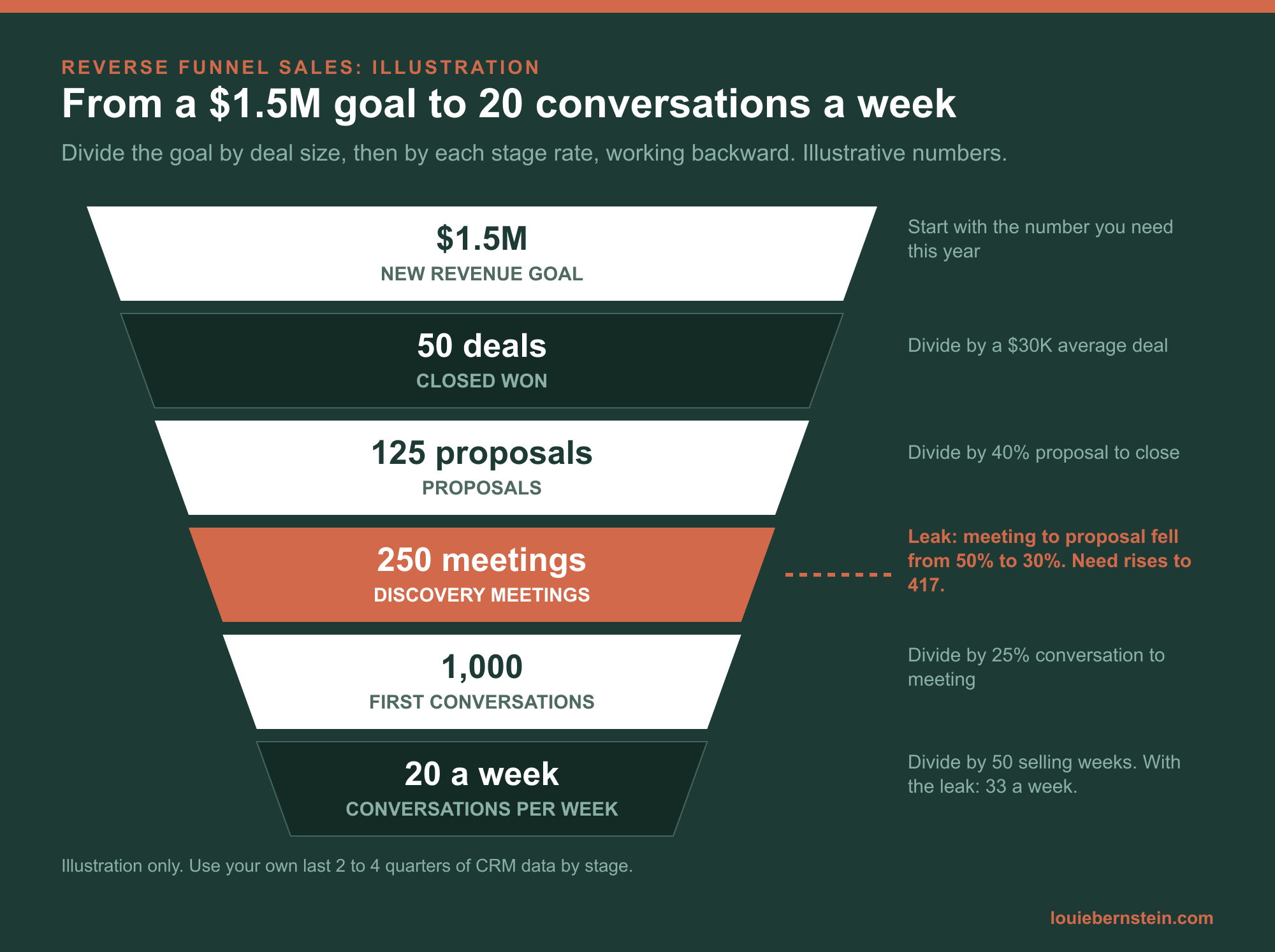
Those rates are made up for the example. Yours will be different, and that's the point. Every input should come from your own business. If you want the goal-setting side of this in video form, watch set your sales goals backwards.
Where do I get my conversion rates for a reverse funnel?
Get your reverse funnel conversion rates from the last 2 to 4 quarters of your own CRM data, stage by stage. Count how many deals entered each stage and how many moved to the next one. If your pipeline stages have no exit criteria, fix that first, because the rates will be fiction.
Why not use industry benchmarks? Because they don't describe your business. Ebsta and Pavilion's 2025 GTM Benchmarks, built on 655,000 B2B opportunities, put the average new-logo win rate at 19%, with new-business deals taking 91 days. That's useful context. It doesn't tell you what your proposal-to-close rate is, and it can't tell you where your leak is.
What I find when I run this math with founders
Here's the pattern I see over and over. We pull the CRM numbers, and before we get to the math, the definitions fall apart. One rep marks a deal "proposal" when a priced quote goes out. Another marks it "proposal" after a friendly email that mentions a number. A third never moves deals at all until they close.
So the CRM says the company converts 70% of meetings to proposals. Nobody in the room believes it, and they're right not to. The rates are an average of three different definitions.
That's why the first step is often not the math. It's agreeing on what each stage means and what has to be true for a deal to move. I walk through how to write those rules in your pipeline stages are fiction. Once the stages mean the same thing to every rep, the reverse funnel becomes something you can trust.
If your reps define "proposal" three different ways, your conversion rates are an average of three different businesses.
How does a reverse funnel show where revenue is leaking?
A reverse funnel shows the revenue leak by comparing each stage's conversion rate with the quarter before and with your best quarter. The stage with the biggest drop is the leak to work on first. Fixing one leaking stage often lowers the weekly activity you need more than any amount of new lead flow raises it.
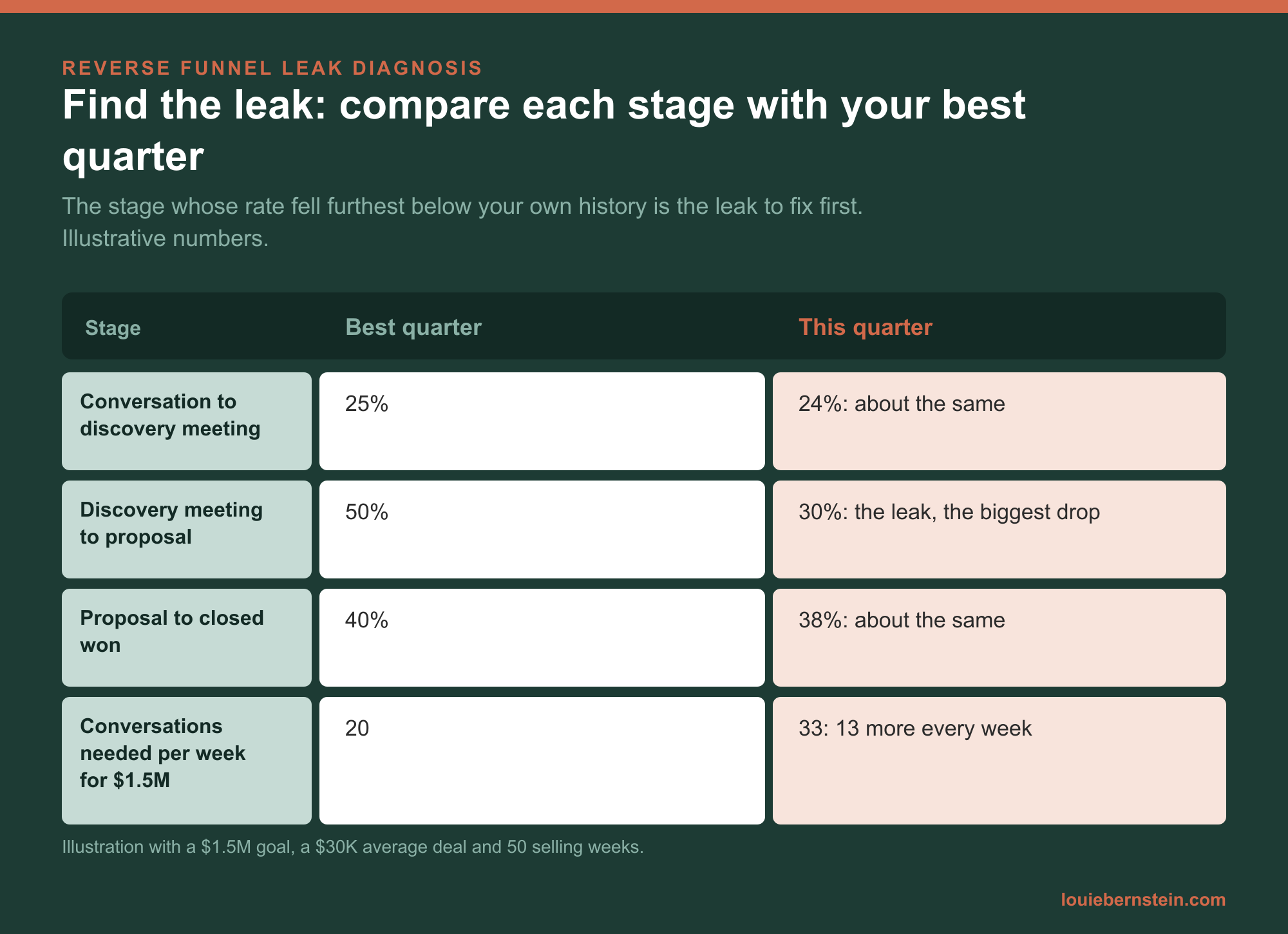
In the example, meeting-to-proposal fell from 50% to 30%. Run the funnel again and the need jumps from 250 discovery meetings to 417, and from 20 conversations a week to 33. Same goal. Same deal size. Thirteen more conversations every week, all because of one stage.
When meeting-to-proposal drops, I look at discovery first. Reps are taking meetings with the wrong buyers, or they're not finding a problem worth solving. When proposal-to-close drops, I look at who's in the deal and whether there's a real reason to buy now.
Slow deals are a leak too
Time leaks revenue as surely as a bad stage does. In Ebsta and Pavilion's 2025 data, a deal that slipped one week past its expected close date still won 18% of the time. At one month it was 13%. At three months, 8%. Past six months, 3%.
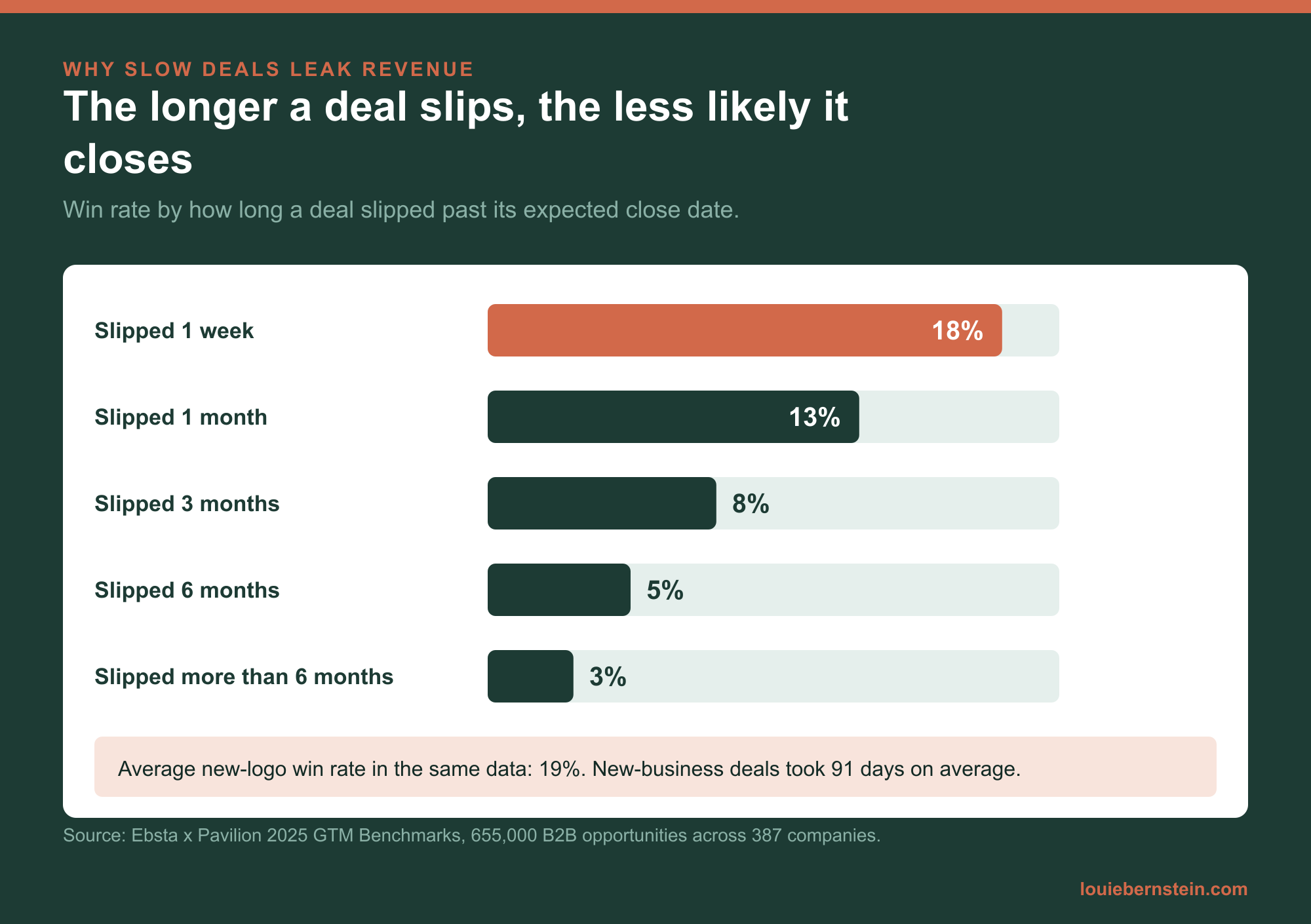
So when you run your reverse funnel, check stage age too. A deal that's been in "proposal" for four months isn't a proposal. It's a hope. Pull it out of the math, or your funnel will tell you you're closer to the goal than you are.
What if the reverse funnel says we need more meetings than we can handle?
If the reverse funnel says you need more meetings than your team can handle, the goal needs better conversion, a bigger average deal or more sellers. The reverse funnel shows which of the three is cheapest to move. Usually the cheapest fix is the leaking stage, because it costs coaching time, not new headcount or new leads.
- Fix the leak. In the example, getting meeting-to-proposal back to 50% cuts the need from 33 conversations a week to 20.
- Raise the deal size. A 20% bigger average deal, $36K instead of $30K, cuts the need from 20 conversations a week to about 17, if the rates hold.
- Add sellers. More reps don't change the math per deal. They add capacity. This is the most expensive lever, so pull it last.
Run each scenario on the same page. Founders are often surprised how much a single stage moves the weekly number. That's the moment the conversation shifts from "we need more leads" to "we need better discovery."
How often should I rerun the reverse funnel?
Rerun the reverse funnel monthly in your pipeline review, and every time the revenue goal, the average deal size or the sales team changes. Monthly is often enough to catch a stage that's slipping before it costs the quarter, and not so often that normal noise looks like a trend.
Keep the page simple: the goal, the rates for the last quarter and your best quarter, and the weekly number for each rep. When a rate moves, ask why in the pipeline review. Over a few quarters, the reverse funnel stops being a calculation and becomes how your team plans the week.
This is a big part of what I build in a 12-week engagement: stages with exit criteria, a CRM the reps actually update, and a monthly review where the reverse funnel gets rerun. Once that's in place, the founder can see the leak without me.
Why Founders Can't Forecast (And Why Gut Feel Breaks at $3M)
Frequently Asked Questions
How many leads do I need to hit my revenue goal?
Divide your revenue goal by your average deal size, then by each stage's conversion rate from proposal back to first conversation. In the illustration in this article, a $1.5M goal with a $30K average deal needs about 1,000 first conversations a year, or 20 a week. Your number depends on your own rates.
Is a reverse sales funnel calculator worth using?
A calculator is fine if you feed it your own numbers. A spreadsheet with five divisions does the same job. The value isn't the tool. It's using real stage-by-stage conversion rates from your CRM and comparing them with your best quarter.
What if I don't have enough deal history yet?
Start with a rough estimate for each stage, label it as a guess, and replace it with real data every month. After two quarters of clean records, you'll have rates worth trusting. The habit of logging every deal by stage matters more than the first numbers.
Should each sales rep have a reverse funnel?
Yes. Give each rep a weekly conversation and meeting number built from their own conversion rates and their share of the goal. Two reps with different rates need different activity to reach the same number, and the gap shows you who needs coaching on which stage.
Does a reverse funnel work for renewals and expansion revenue?
Build a separate one. Expansion deals convert differently: Ebsta and Pavilion's 2025 data shows a 45% win rate for expansion versus 18% for new business, with a 52-day cycle versus 91. Mixing them in one funnel hides the leak in both.
Find your leak before you buy more leads.
If you're a B2B founder at $1M to $10M ARR and your revenue goal feels like a wish, let's build your reverse funnel together and find the stage where revenue is slipping away. Learn about Fractional Sales Leadership at LouieBernstein.com.
Schedule a 30-Minute CallAbout the Author

Louie Bernstein Fractional Sales Leadership
Louie Bernstein is a Fractional Sales Leader with 50 years of sales experience and has worked as a Fractional Sales Leader since 2017. He built and ran MindIQ for 22 years. He helps B2B founders at $1M to $10M ARR build repeatable sales systems so selling doesn't depend on the founder.