What Do the Case Walkthroughs Reveal About the Cost of Waiting Versus Acting?
When founders calculate the real cost of founder-led sales and act early, they hand off deals while they still have spare hours to coach a new rep. When they stay too long, deals slip, win rates fall, and the late hire ramps for six months while the founder is drowning. Exiting too fast fails too. In my experience, the founders who do best start a staged exit the quarter their calendar crosses about 70% booked.
Key Takeaways
- Founders who act on the cost of founder-led sales early keep their best deals, write the playbook, and hire while they still have time to coach. Founders who stay too long hire in a panic and pay for it twice.
- Waiting is expensive because slipped deals close far less often: 44% of deals were pushed, and win rates fell 67% when a deal slipped (Ebsta/Pavilion, 2024, 4.2M opportunities).
- A late hire doesn't fix the problem quickly. The average AE takes 6.2 months to ramp, and only 48% of reps hit quota (Bridge Group, 2026, 158 B2B companies).
- In an illustrative $3M ARR company, staying over capacity costs about $67K of expected bookings a quarter, or about $134K across one rep's ramp.
- Exiting sales overnight is as risky as staying too long. Hand off in stages: smallest deals first, strategic deals last.
- This week, pull your last 30 days of calendar and count how much of your selling time is already booked. Above 70% for a full quarter, start the handoff.
Most founders I talk to have already done the math. They know founder-led sales is costing them. Knowing the number and acting on it are two different things, and the founders who act early and the founders who wait one more quarter end up in very different places a year later.
Every founder eventually leaves founder-led sales. The only choice is whether you leave on a plan or on a stretcher.
Below are three walkthroughs, plus my own story from MindIQ. The three cases are composites of patterns I see in founder-led companies, and the dollar figures in them are illustrative, not client results. The research numbers are real and cited.
What Happens When a Founder Calculates the Cost and Acts Early?
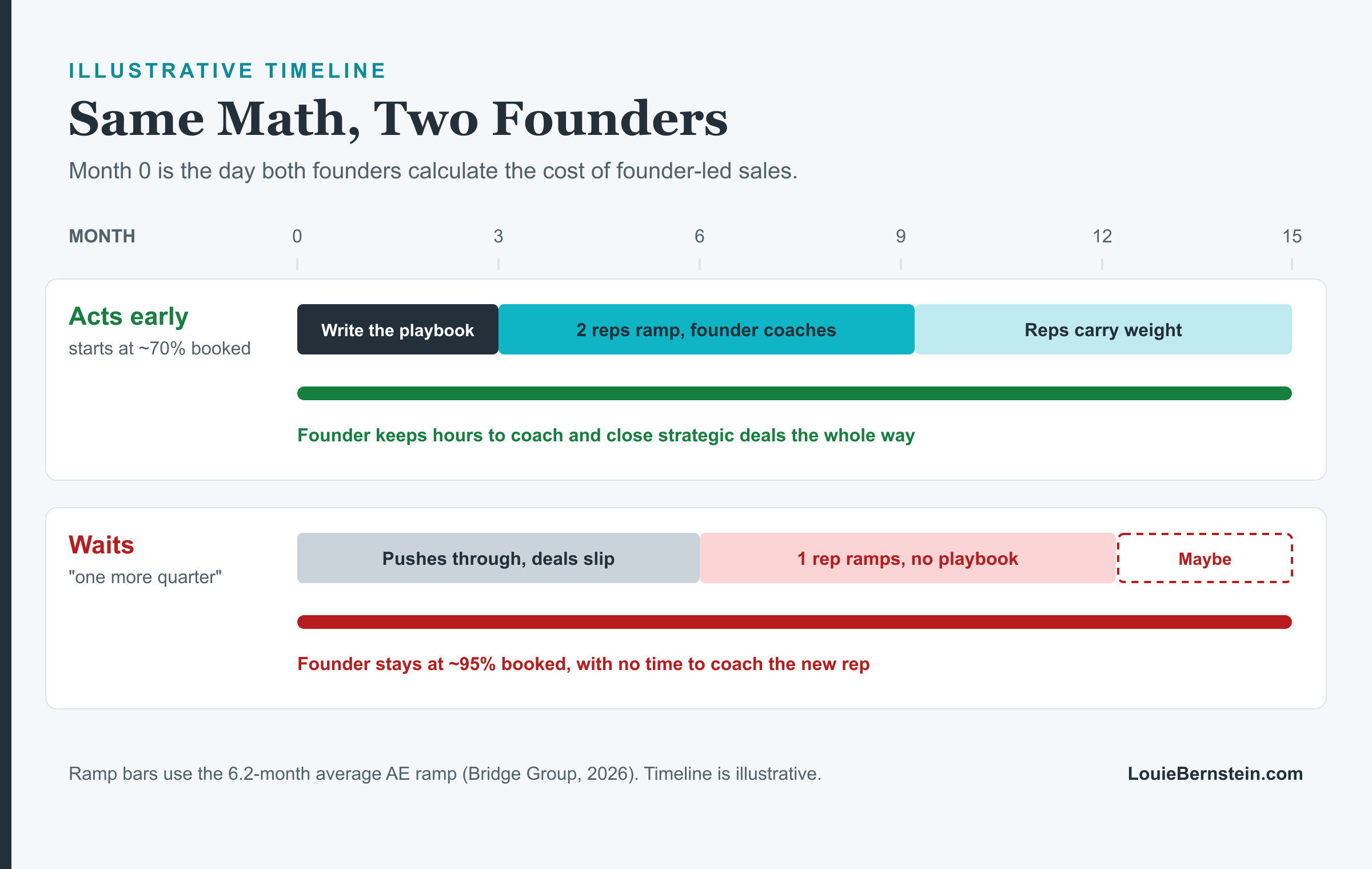
A founder who acts on the cost of founder-led sales early keeps closing the strategic deals, documents the sales process, and hires reps while there's still time in the week to coach them. The handoff is slower than the founder wants, but revenue keeps moving, because nobody is learning the job in the middle of a crisis.
Case 1: The early mover at $2.5M ARR
Picture a founder at $2.5M ARR selling a $40K annual contract. Her selling hours are about 70% booked. Deals aren't slipping yet, but proposals that used to go out the same day now take two or three.
She runs the numbers and decides yellow is the signal, not red. Over the next quarter she does four things:
- Writes down her ideal customer, qualification rules, stages and pricing limits in a Sales Playbook.
- Writes an Accountabilities Document so every decision in a deal has one owner.
- Hires two reps, not one, so she can tell a bad rep from a bad process.
- Hands them the smallest deals first and keeps the five or six strategic accounts herself.
What acting early actually buys
Acting early buys coaching time, not instant revenue. The new reps still take months to ramp, but the founder has hours to ride along on calls and fix the playbook as the reps find its holes. Her own deals don't slip, and the reps learn on low-risk deals.
What Happens When a Founder Stays in Sales Too Long?
A founder who stays in sales too long waits until the calendar is full and deals are slipping, then hires in a panic. The new rep starts with no playbook and a founder with no time to coach, and the slipped deals keep losing while the rep ramps. The company pays for the delay twice: in lost deals and in a failed hire.
Case 2: The late mover at $4M ARR
Now picture a founder at $4M ARR with the same $40K deal. He saw the cost a year ago and decided to push through one more quarter. Then one more. His sales calendar is now 95% booked and close dates slide.
A big deal goes dark, and he finally hires one rep, with no written process and a "watch me sell" onboarding. The rep gets the overflow deals, which are the ones that have already slipped.
Slipped deals are the worst place to learn. Ebsta and Pavilion found 44% of deals were pushed, and win rates fell 67% when a deal slipped, especially when the delay ran past eight weeks (Ebsta/Pavilion, 2024, 4.2M opportunities across 530 companies). Meanwhile the average AE takes 6.2 months to ramp, the longest in the study's history (Bridge Group, 2026, 158 B2B companies). Six months in, the rep is behind, the founder is still over capacity, and the board asks why sales got worse after the hire.
My own version of this case
I lived Case 2. I ran MindIQ for 22 years, and for a long stretch I was my own best salesperson. My need to be in on every deal was a ceiling on the company's growth, and I didn't see it because my win rate looked fine. I hired my first two salespeople without a playbook, and it was a costly, frustrating mistake.
The bigger cost didn't show up on the P&L. About 20 years in, I hit a wall and was diagnosed with job burnout and depression. Staying too long isn't just a revenue problem. It's a founder problem, and the founder is the one asset the company can't replace on short notice.
What Happens When a Founder Exits Sales Too Fast?
A founder who exits sales too fast hands every deal to a new hire at once and steps away. Revenue can look fine for a quarter or two, because the deals already in motion still close. Then discounts creep up, qualification slips, and the forecast stops meaning anything, because the founder's judgment left with the founder.
Case 3: The overnight exit at $3M ARR
Picture a third founder at $3M ARR who reads the same math, panics in the other direction, and hires a senior seller to "take sales off my plate." She stops joining calls the next week.
The deals she was carrying close on her relationships. The new deals don't, because nobody wrote down which buyers she walked away from, which discounts she refused, or what a qualified deal looked like. Two quarters later she's back in every deal and convinced handoffs don't work. I covered the warning signs in what breaks when a founder steps out too early.
The early mover and the overnight exit aren't the same
The difference between Case 1 and Case 3 isn't timing. Both founders acted early. The early mover handed off in stages and stayed close enough to coach. The overnight exit handed off everything at once and left. A founder-led sales exit should be a ramp, not a cliff.
How Much Does Waiting One More Quarter Actually Cost?
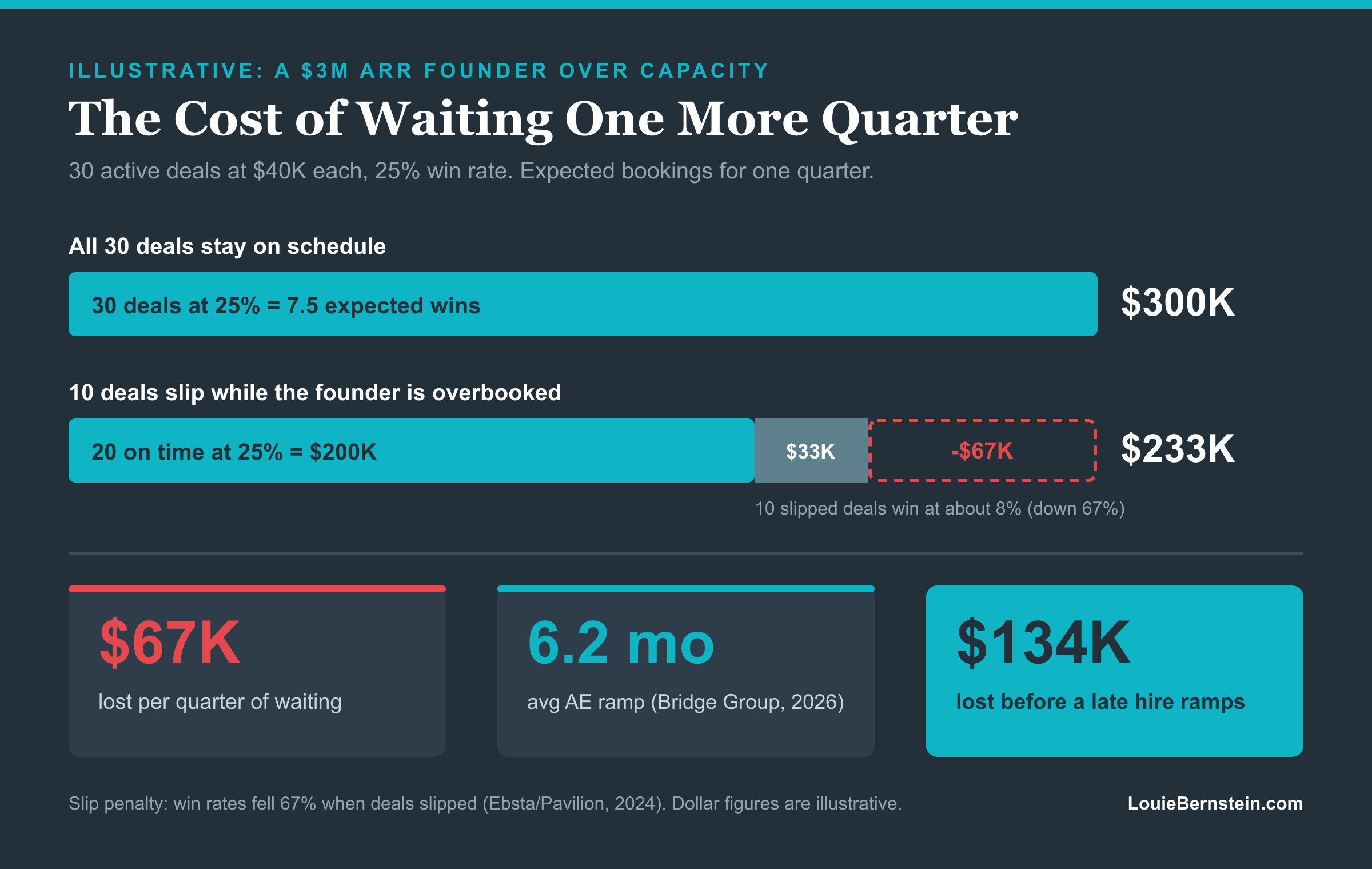
Waiting one more quarter to leave founder-led sales costs the expected value of every deal that slips while you're over capacity. In an illustrative $3M ARR company, that's about $67K of expected bookings a quarter, and about $134K across the two quarters a new rep needs to ramp.
The illustrative math
Take 30 active deals at $40K each with a 25% win rate. If every deal stays on schedule, expected bookings are $300K a quarter. Now say the founder is over capacity and 10 of those 30 deals slip. If slipped deals lose 67% of their win rate, in line with the Ebsta/Pavilion finding, they win at about 8% instead of 25%.
- 20 on-time deals at 25%: 5 expected wins, $200K.
- 10 slipped deals at about 8%: 0.8 expected wins, about $33K.
- Total: about $233K instead of $300K, a loss of about $67K that quarter.
A rep hired at that point takes about 6.2 months, roughly two quarters, to ramp. If the founder stays over capacity the whole time, the gap is about $134K of expected bookings before the new rep carries weight. Run it with your own deal size, win rate and slip count.
Acting early versus waiting, side by side
| Founder who acts early | Founder who waits |
|---|---|
| ✓ Starts at about 70% booked | ✕ Starts at 95% booked, after a lost deal |
| ✓ Writes the playbook before hiring | ✕ Hires first, "teaches by shadowing" |
| ✓ Hires two reps to compare | ✕ Hires one rep and can't tell why they fail |
| ✓ Hands off small deals first | ✕ Hands off the deals that already slipped |
| ✓ Has hours to coach during the ramp | ✕ Is still over capacity during the ramp |
| ✓ Keeps the strategic deals until the reps are ready | ✕ Either keeps everything or drops everything |
Where Do Founders Usually Get the Exit Decision Wrong?
Founders usually get the exit decision wrong by treating the cost calculation as the decision. The math tells you founder-led sales is expensive. It doesn't make you move. What makes most founders move is a lost deal or a bad week, and by then they're deciding under pressure instead of on a plan.
What I see when I audit founder-led sales teams
When I sit down with a founder who's stayed too long, most can tell me roughly what founder-led sales costs them. What they can't tell me is the date they'll start the handoff. "After this quarter" is the most expensive answer in founder-led sales, because there's always another big quarter coming.
The second mistake is hiring one salesperson to test the waters. Over nine years as a Fractional Sales Leader I've come to believe one equals zero: with a single rep, you can't tell whether the rep failed or your process did. I explain the fix in why founders should never hire one salesperson.
The third mistake is hiring without the cash to carry the rep through a full sales cycle. If your cycle runs six months and you can only fund three, you'll judge the rep before they've had a fair shot.
The fear underneath the delay
There's a fear founders rarely say out loud: what if the handoff works, and it proves I was the bottleneck all along? I had that fear at MindIQ. If the motion grows when someone else runs it, that's not an indictment of you. It's evidence the company outgrew the way it was built.
How Do You Run the Exit Calculation on Your Own Company?
To run the exit calculation, measure how full your sales calendar is, how many of your deals are slipping, and what a slipped deal costs you. Then set a start date for the handoff, not a revenue target. The goal is to begin while you still have hours to coach, which usually means a quarter or two earlier than feels comfortable.
- Measure your booked selling time. Pull the last 30 days of your calendar. If your sales hours run above 70% booked for a full quarter, you're in the yellow zone. That's my rule of thumb, not a research benchmark.
- Count slipped deals. List every open deal whose close date has moved. Note how many are waiting on you.
- Price the slip. Multiply slipped deals by your deal size, your win rate and the share of win rate you lose when a deal slips. Use your own history if you have it.
- Add the ramp. Assume about six months before a new rep carries weight. Multiply your quarterly slip cost by two.
- Set the date. Pick the week you'll start writing the playbook. Put it on the calendar you just measured.
If you want a deeper read on the three numbers behind step 1, here's how to tell when founder-led sales costs more than it returns.
Where a Fractional Sales Leader fits
Founders who stay too long are usually short on hours, not intent. A full-time VP of Sales costs $250K to $400K a year. Most fractional sales leaders run $10K to $20K a month. I charge $14K a month for 20 to 35 hours a week, in 12-week renewable engagements, at roughly half the cost of a full-time VP. In the illustrative math above, one 12-week engagement costs about $42K, against about $67K of slipped bookings in a single quarter of waiting.
Related Reading
Frequently Asked Questions
How do I know if I've already stayed in sales too long?
You've likely stayed too long if your sales calendar is above 90% booked, close dates are sliding quarter to quarter, and buyers wait days for proposals you used to send the same day. Two of those three together means the cost of waiting is already showing up in your pipeline.
Should I stop selling completely once I hire?
No. Keep the handful of strategic deals only you can win, and hand off the smaller deals first. Pull back from the strategic deals in stages as your reps prove they can follow the playbook. A full stop on day one is how Case 3 happens.
Is it ever right to wait another quarter?
Waiting makes sense if you don't yet have the cash to carry two reps through a full sales cycle. In that case, use the quarter to write the playbook and Accountabilities Document, so the hire starts on a plan the day the cash is there.
How long does a founder-led sales exit take?
Plan on most of a year from the first written playbook to reps carrying real weight. The ramp alone averages 6.2 months for an AE (Bridge Group, 2026), and documenting the process before you hire usually takes another quarter.
Are the dollar figures in these cases real client results?
No. The three cases are composites built from patterns I see in founder-led companies, and their dollar figures are illustrative math. The research figures on slipped deals and ramp time come from the Ebsta/Pavilion 2024 and Bridge Group 2026 studies. Run the math with your own numbers.
Find out what waiting is costing you
Bring your calendar and your open deals. In 30 minutes we'll price your slipped deals, look at your ramp, and set a start date for your handoff. Learn more at LouieBernstein.com.
Schedule a 30-Minute ConversationAbout the Author
Louie Bernstein is a Fractional Sales Leader with 50 years of sales experience and has worked as a Fractional Sales Leader since 2017. He founded and ran MindIQ, an Inc. 500 company, for 22 years. He helps B2B founders at $1M to $10M ARR build repeatable sales systems and teams that can sell without the founder in every conversation.
Subscribe to The Sunday Starter for practical sales leadership advice.