Post-demo follow-up for founders

Why do my buyers go dark after a great demo?

What checklist can I give my champion to sell internally without me chasing?

The demo went well. Everyone nodded. Then nothing. Your buyer didn't lose interest. The deal walked into a meeting you weren't invited to, and nobody brought the case with them.

Founder waiting on a buyer who went dark after a great demo

By Louie Bernstein·Last updated October 25, 2026

Short answer: Buyers go dark after a great demo because the deal moves inside their company and stalls there. Nobody owns the next step, the champion can't retell your pitch, and the rest of the buying group hasn't agreed. Before the demo ends, book the next meeting and hand your champion a five-item checklist they can forward.

Key takeaways

  • A buyer who goes dark after a great demo is usually stuck in an internal conversation, not lost to a competitor.
  • The Post-Demo Gap is the stretch between your demo and the buyer's first internal meeting. Most deals that go quiet die there.
  • Never end a demo without a next meeting on the calendar: who does what, by when, and when you meet again.
  • Matt Dixon's research on 2.5 million sales calls found 40% to 60% of deals are lost to the customer doing nothing (The JOLT Effect).
  • The Champion Hand-Off Checklist gives your champion five things to carry into the room, so you stop chasing and start getting answers.

What should my champion leave the demo with?

The Champion Hand-Off Checklist is five items your champion has in hand before the demo ends, so they can sell your solution inside their company without you in the room. It fills the Post-Demo Gap: the days between your demo and the buyer's first internal meeting, when nobody on the buyer's side owns the next step.

Your demo is the last time you control the deal. After you hang up, your champion has to explain your product to a CFO, an IT lead and a boss who all have other priorities. If your champion walks away with only good feelings, the deal goes quiet. Spend the last 10 minutes of every demo on these five items.

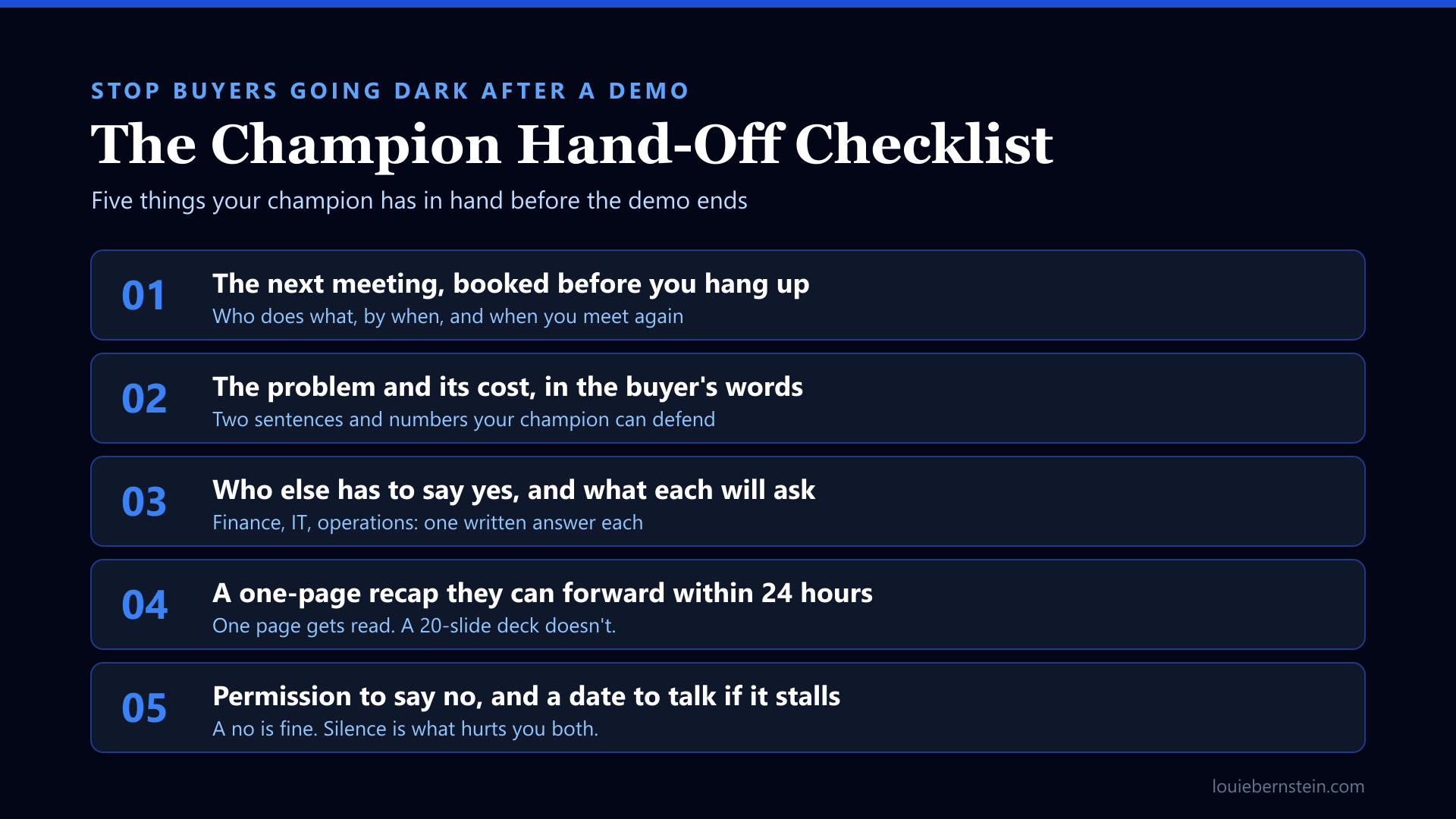
The Champion Hand-Off Checklist: five items to give your champion so buyers don't go dark after a demo
01

The next meeting, booked before you hang up

At the end of the demo, ask, "Did I cover what everyone wanted to see?" Then ask the decision maker, "What's the next step?" When they answer, ask, "Then what happens?" Keep asking until you know the path to a decision. Pin down who is going to do what, when it will be done, and when you meet again. Send the calendar invite while everyone is still on the call.

What you get: a dated next step on both calendars, so silence means something changed, not that you forgot to follow up.
02

The problem and its cost, in the buyer's words

Write two sentences your champion would actually say to their boss. Use their language from discovery, not your marketing copy. Add what the problem costs them per year, using numbers your champion gave you. A champion can defend their own numbers in a budget meeting. They can't defend yours.

What you get: a case your champion can repeat in two minutes without slides.
03

Who else has to say yes, and what each will ask

Ask, "Who besides you needs to be comfortable with this, and what will they push back on?" List each name with their likely question. Finance asks about payback. IT asks about security. Operations asks who does the extra work. Write a one or two sentence answer for each person your champion names.

What you get: no surprise objections in a meeting your champion has to run alone.
04

A one-page recap they can forward within 24 hours

Send a single page the same day: the problem, the cost, what they saw in the demo that solves it, the answers by person, and the dates you agreed to. Your champion will paste parts of it into Slack and read from it in their internal meeting. A 20-slide deck won't get opened. One page will.

What you get: your case arrives in the room even when you don't.
05

Permission to say no, and a date to talk if it stalls

Before you hang up, say, "If this gets stuck inside, or the answer turns into no, will you tell me? A no is fine. Silence is what hurts us both." Agree on a date to check in if the internal meeting slips. Now a quiet week isn't ghosting. It's a missed commitment you both agreed to discuss.

What you get: an honest answer instead of weeks of chasing, and a cleaner forecast.

Why do buyers go dark after a great demo?

Buyers go dark after a great demo because the decision leaves the room with your demo and enters a meeting you don't attend. Gartner's 2025 survey of 632 B2B buyers found 74% of buying teams show unhealthy conflict during the decision. When finance, IT and the boss disagree, doing nothing is the safest choice, and your champion goes quiet because they have no good news to report.

Founder-led sales makes the Post-Demo Gap wider. Your demo works because you're the one giving it: the stories, the timing, the answers to the hard questions. Your champion can't repeat that. If you're seeing the same pattern across your pipeline, the silence isn't one bad buyer. It's a process problem, and it's the same reason most B2B deals stall in the middle of the pipeline.

Matt Dixon and Ted McKenna's study of 2.5 million recorded sales conversations found 40% to 60% of deals are lost to the customer doing nothing (The JOLT Effect, 2022). The fix isn't more follow-up emails. Give your champion what they need before you hang up, and when money is involved, help them build a business case they can take to the CFO.

What 50 years in sales taught me about the next step

In my CRM there's a required field labeled Next Step. You can't save the record until it's filled in. That rule came from watching good deals die after good meetings. I teach every salesperson I coach the same thing: never end a call, a meeting or a demo without a next step. If you don't know what it is, ask the prospect. Another rule I live by: it's okay to win a deal alone, but never lose one by yourself. When a buyer goes dark, ask who could have helped you see it coming, and bring them in sooner next time.

Sources: Statistics on this page come from primary sources: Gartner buying group survey (2025) · Matt Dixon on customer indecision (CustomerThink)

Chasing a buyer vs. handing off to a champion

Most founders respond to a buyer going dark by sending more emails. The table shows what changes when the champion leaves the demo with the checklist instead.

Chasing after the demoChampion Hand-Off Checklist
The demo ends with "I'll take this to the team."The demo ends with a dated next meeting on both calendars.
Your champion retells your pitch from memory.Your champion reads from a one-page recap in their own words.
Finance and IT raise objections nobody prepared for.Each person's likely question already has a written answer.
You send "just checking in" emails for three weeks.You check in on the date you both agreed to.
Silence stays in the forecast as a maybe.A missed commitment triggers a direct conversation, or a clean no.
Only the founder can rescue a quiet deal.Any rep can run the checklist on every deal.

What do I do when a buyer has already gone dark?

When a buyer has already gone dark, stop sending reminders and ask one question that's easy to answer. Your goal is a real answer, yes or no, so you can decide where to spend your time.

  1. 1.

    Send one short email that asks for a decision

    Write three lines. Name the problem they told you about, ask whether it's still a priority this quarter, and say a no is fine. "Has this moved down the list?" gets more replies than "Just checking in." A buyer can answer it in five seconds without feeling cornered.

  2. 2.

    Reach your second contact

    If you built more than one relationship during the sale, call the other person and ask what happened inside. They'll often tell you the real story: a budget freeze, a reorganization, a skeptic in finance. If you only had one contact, that's the lesson for your next deal.

  3. 3.

    Move the deal out of your forecast

    After two attempts with no reply, take the deal out of your committed number and put it on a 90-day nurture list. Honest pipelines make better decisions. Hoping a quiet deal comes back is how founders miss their quarter.

About Louie Bernstein

Louie Bernstein, Fractional Sales Leader who helps B2B founders at $1M–$10M ARR escape founder-led sales.

Louie has 50 years of sales experience and has worked as a Fractional Sales Leader since 2017. He founded MindIQ, an Inc. 500 company. He builds the Sales Playbook, pipeline stages and coaching rhythm that let a founder's team close deals without the founder on every call, at roughly half the cost of a full-time VP of Sales.

Read Louie's full background

Frequently asked questions

How long should I wait to follow up after a demo?

Send the one-page recap the same day, while the demo is fresh. After that, follow up on the date you agreed to before you hung up. If you didn't agree on one, wait three to five business days, then send a short email asking whether the problem is still a priority this quarter.

What should I send a prospect after a demo?

Send one page your champion can forward: the problem in their words, what it costs them, what they saw in the demo that solves it, answers to the questions each stakeholder will ask, and the next meeting date. Skip the 20-slide deck. Your champion won't open it, and nobody else will either.

Is the Champion Hand-Off Checklist the same as a mutual action plan?

No. A mutual action plan maps every step from evaluation to signature, with owners and dates. The Champion Hand-Off Checklist covers the first internal meeting after your demo. Use the checklist on every demo, and add a mutual action plan once the buyer agrees to a formal evaluation.

How many times should I follow up before giving up on a prospect who went dark?

Try twice with something useful each time, such as a direct question or a relevant example. If you still hear nothing, tell the buyer you'll close the file and stay in touch quarterly. Then take the deal out of your forecast. A clear no frees your time for buyers who are moving.

Why do prospects go silent after saying the demo was great?

Prospects go silent after a great demo because liking your product is not the same as getting their company to agree. Your contact has to win over finance, IT and their boss. If they can't answer those people's questions, they stop replying to you rather than share bad news.

Related reading

Stop chasing buyers after great demos.

If you're a $1M to $10M ARR founder and your deals keep going quiet after the demo, let's look at your biggest open deal together. In 30 minutes we'll decide what your champion needs to carry it into the room.

Talk to Louie for 30 Minutes