If only you can quote the price, every deal waits on you. Complex pricing slows the rep on the call, confuses the champion who has to sell it inside their company, and invites negotiation on every variable. The fix is a price a rep can say out loud in one sentence: a tier, one unit the buyer already counts, and a term. Test it with four questions before you change anything else.
Key Takeaways:
- If your rep has to say "let me get back to you on pricing," the deal just moved onto your calendar.
- Your champion has to repeat your price to people you'll never meet. Gartner puts B2B buying groups at five to 16 people across as many as four functions (Gartner, 2025).
- Every extra pricing variable is another thing the buyer can negotiate.
- A simple price has three parts: a tier, one unit the buyer already counts, and a term.
- Run the four-question simplicity test: can a rep quote it, can the champion repeat it, can the buyer estimate next year's bill, and does it fit on one slide?
- Once the price is simple, put discount limits and exception rules in writing so pricing stops coming back to your desk.
Picture a first call that's going well. The buyer has a real problem. They like what they hear. Then they ask the question every buyer asks: "So what does this cost?"
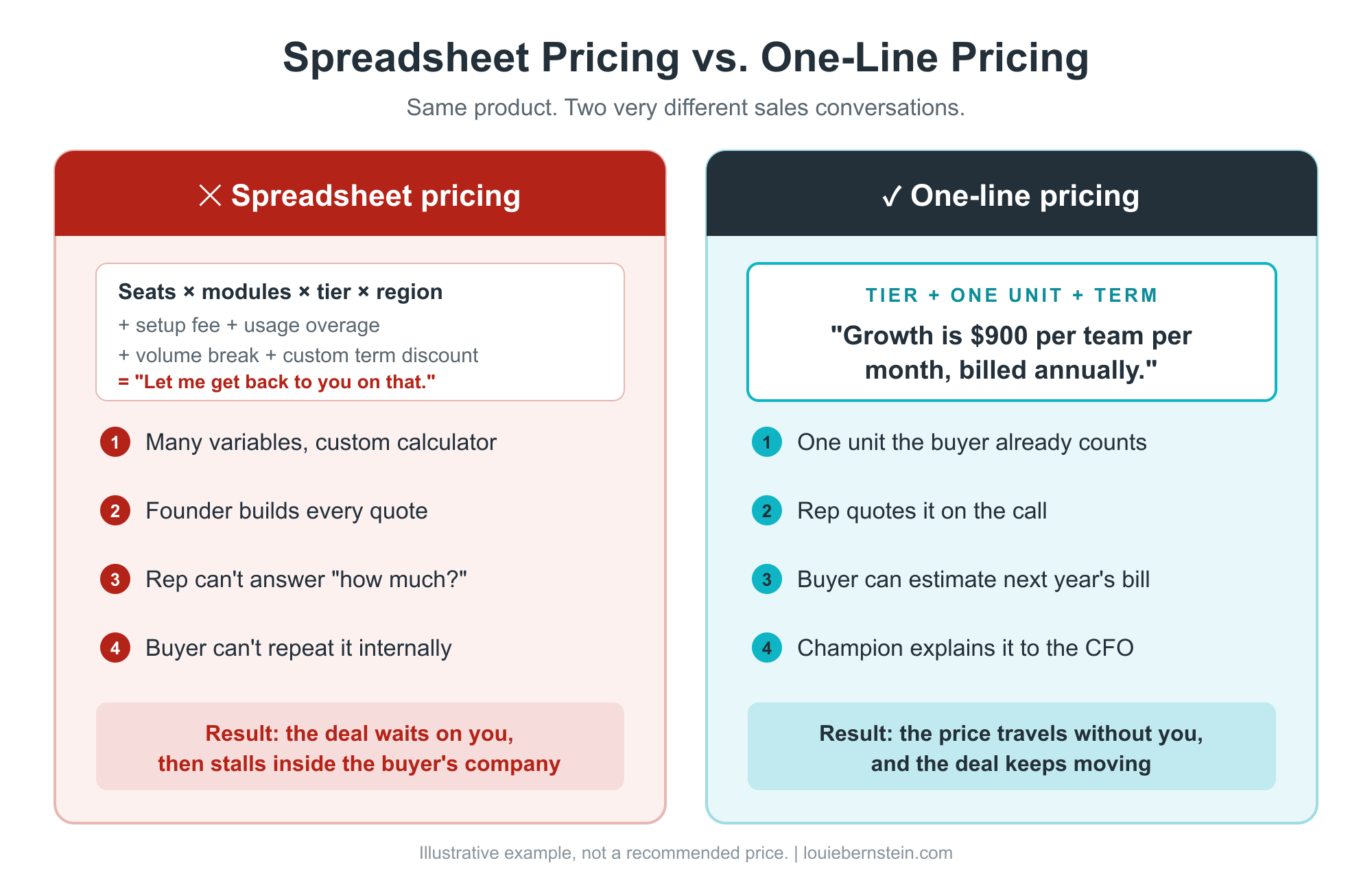
Your rep hesitates. The honest answer depends on seats, modules, a setup fee, a usage band, and whatever discount you gave the last customer who looked like this one. So the rep says, "Let me put together a quote and get back to you."
That sentence costs you more than it sounds. The quote goes to you. You're on three other calls. Two days later you build it in a spreadsheet. By the time it lands, the buyer's energy from the first call has cooled.
This is one of the quietest ways founder-led sales stays founder-led. The price itself isn't too high. It's too hard to say. And a price only you can say is a price only you can sell.
“If your pricing needs a spreadsheet, the deal needs you. And a deal that needs you can't scale.”
Why does complex pricing slow down B2B deals?
Complex pricing slows deals in three places. The rep can't answer on the call, so the quote waits on the founder. The champion can't explain it inside their company, so the deal stalls there. And every variable becomes something to negotiate. Each delay is small. Together they drain the momentum a good first call creates.
The quote waits on you
When pricing takes judgment, the judgment lives with the founder. So every quote routes through you. That turns your calendar into the speed limit for your whole pipeline.
It also teaches your reps a bad habit. They learn to stop at the price instead of owning it. In my sales training years ago, I wrote that if a company only needed someone to give out prices, it could publish a price list. You hire a salesperson to understand the buyer's problem well enough to recommend the right answer. They can't do that job if they can't say what the answer costs.
The buyer can't repeat it
Your contact is rarely the only person who decides. Gartner found that buying groups range from five to 16 people across as many as four functions. It also found that 74% of B2B buyer teams show "unhealthy conflict" during the decision (Gartner, 2025).
Now hand that group a price that takes a spreadsheet to explain. Your champion walks into a budget meeting and has to rebuild your logic from memory. The CFO asks one question they can't answer. The deal goes back to "let's revisit next quarter."
You won't hear about that meeting. You'll just notice the deal went quiet.
Every variable is a negotiation
Five pricing variables give the buyer five places to push. Can you waive setup? Can you count seats differently? Can you give us next year's module free? A simple price gives them fewer places to push. The conversation stays on value instead of on your formula.
“Your champion sells your price in meetings you'll never attend. Give them a sentence, not a spreadsheet.”
How do I know if my pricing is too complicated?
Your pricing is too complicated if your reps can't quote it on the first call, if two similar customers pay very different prices, or if you're the only person who knows the "real" number. Look at your last ten proposals. If most needed you to build or approve the price, the complexity is costing you deals.
Here are the warning signs I look for when I start with a founder:
- The rep's most common line is "let me check." Ask your reps how often they defer pricing to you. If the answer is "most of the time," you have your answer.
- There's a master spreadsheet. A tab for seats, a tab for modules, a tab for discounts. Only you and maybe one other person understand it.
- Similar customers pay very different prices. Pull five customers with about the same size and use. If the prices are all over the map, your price is being set by each negotiation, not by your pricing.
- Proposals go through several versions. Each version changes a variable. None of them change the value.
- Buyers ask for a call to "walk through the pricing." If your proposal needs a guided tour, the buyer's boss won't take the tour.
None of this means your product is simple. Many products do complicated things. The price that sits on top of them doesn't have to be.
Related ReadingGood-Better-Best: Package So Buyers Choose Faster →
How do I simplify my pricing without leaving money on the table?
Simplify pricing by cutting it down to three parts: a tier, one unit the buyer already counts, and a term. Move rare needs into a short list of approved add-ons, and handle true edge cases as priced exceptions. You keep the revenue. You just stop making every buyer pay for your formula with their time.
Step 1: Pick one unit the buyer already counts
The best pricing unit is something the buyer already tracks. Teams, locations, users, sites, projects. If the buyer has to measure something new just to predict your bill, the unit is wrong.
Choose the unit that grows as the customer gets more value. That way your revenue grows with their success, and the price feels fair when it goes up.
Step 2: Collapse the options into tiers
Most spreadsheet pricing started as a list of modules. Group them into packages built around buyer situations, not your feature list. Three is a good starting point. I covered how to design them in Good-Better-Best packaging.
If a module is bought by almost every customer, it belongs inside a tier. If almost nobody buys it, ask whether it belongs on the price list at all.
Step 3: Name the term, then stop adding variables
Pick a standard term, such as annual, and a standard way to pay. That's the whole price. Anything else, like setup, training, or data migration, goes on a short list of add-ons with fixed prices. If an add-on shows up in most deals, fold it into a tier.
Step 4: Write the one-sentence price
Write your price as a single sentence a rep can say out loud. Here's a hypothetical example: "Our Growth plan is $900 per team per month, billed annually." If you can't write that sentence for your offer, you're not done simplifying.
Then read it to someone who doesn't work at your company. Ask them to repeat it back. If they can, a champion can too.
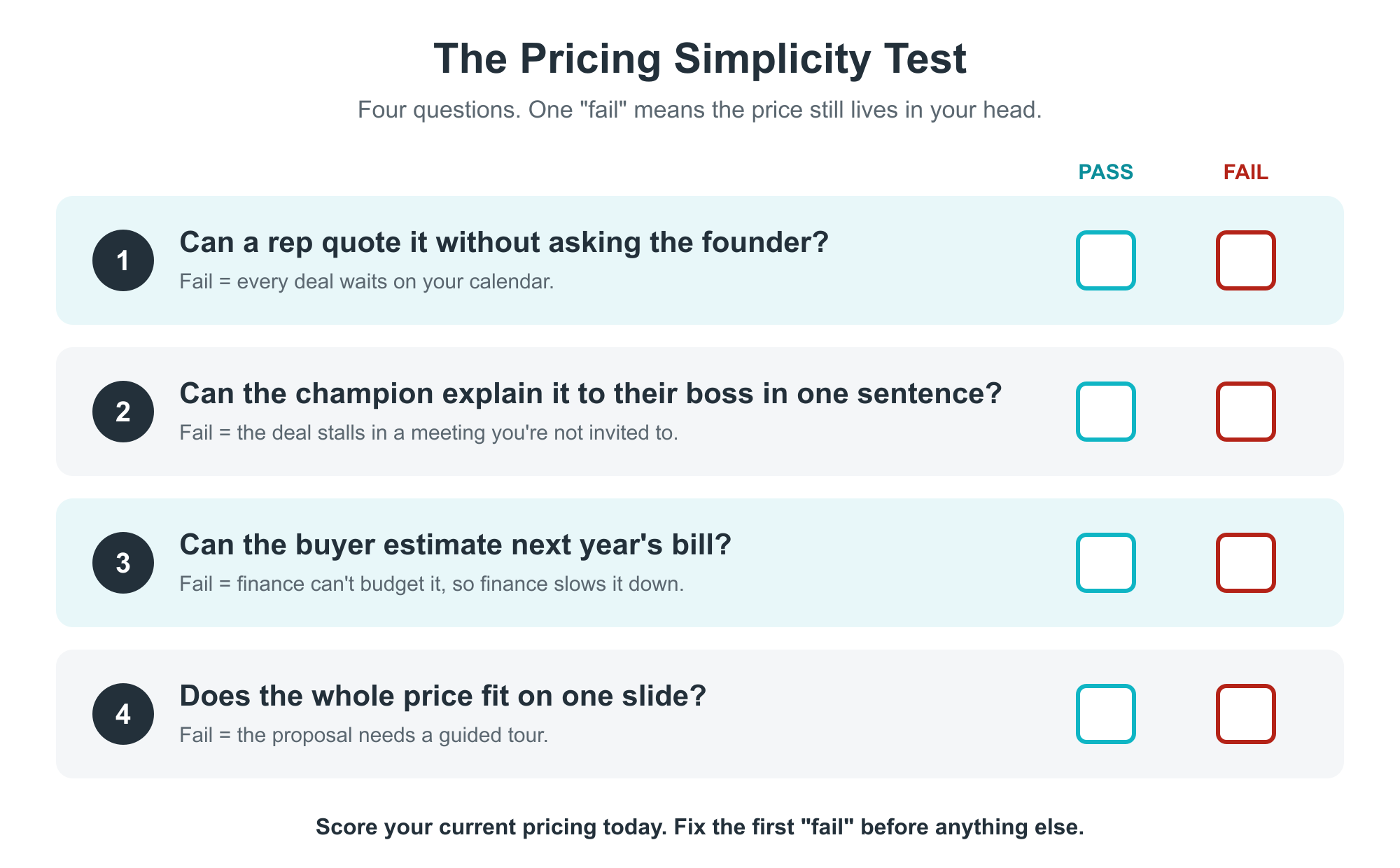
Run the simplicity test
Score your current pricing against the four questions above. Be honest. Then score the new version. You're looking for four passes.
Protect your margin while you do this. Before you publish the simpler price, check that each tier still covers the cost to deliver it. I walked through that math in Cost-Plus Pricing Is Killing Your Margin. Simpler doesn't mean cheaper. It means easier to say yes to.
What should my rep say when a buyer asks "how much does it cost?"
Your rep should give the starting price on the call, in one sentence, and then check it against the buyer's budget. Don't dodge the question and don't promise a quote later. A clear answer builds trust, and it tells you early whether the deal is real or whether you're about to spend weeks on a buyer who can't afford you.
I've taught a version of this line for years. Once you've been talking with a prospect for a while, say something like:
"Maria, I want to make our pricing clear so you can plan. Our Growth plan is $900 per team per month, billed annually. For three teams, that's about $32,000 a year. Is there at least that much set aside for solving this?"
Then stop talking. If the answer is yes, keep going. If the answer is no, you just saved both of you a month. I call that accelerating the inevitable. A deal that was never going to close at your price is better lost on day one than on day sixty.
Two notes for founders. First, give your reps the authority to say the number. A price they have to clear with you isn't a price they can quote. Second, practice it. Role-play the pricing question in your sales meeting until every rep can answer it without looking at a document.
“A price your rep can't say out loud is a price your rep can't sell.”
Related ReadingThe Discount Trap: Why Founders Give Away Margin to Close Deals →
How do I keep pricing from landing back on my desk?
Keep pricing off your desk by writing down three things: who can approve which discounts, which exceptions are allowed, and where every quote gets recorded. A simple price only stays simple if the rules around it are clear. Without them, reps bring every unusual request back to you, and the spreadsheet grows back.
Write down discount authority
Decide how much a rep can approve on their own, what needs you, and what nobody approves. Every discount should get something back, like a longer term or faster payment. Put it in the Sales Playbook, not in your head.
Track the quote in the CRM
Add the tier, the unit count, the list price, and the final price to every deal. If it isn't in the CRM, it never happened. Review the gap between list and final price each month. That's where you'll see whether your simple price is holding.
Decide whether you need a quoting tool
Founders often ask me whether they need CPQ software (configure, price, quote). At $1M to $10M ARR, usually not yet. A CPQ tool automates the complexity you already have. Simplify first. Then, if you still need help producing quotes, a template in your CRM is often enough.
Why this matters for keeping good reps
Salespeople don't quit companies. They quit chaos. A rep who can't quote a price, who waits days for a number, and who watches deals cool while they wait will get frustrated. A clear price, clear rules, and the authority to use them give that rep a job they can win at.
After 50 years in sales, including 22 years building MindIQ into an INC 500 company, this is the pattern I trust most: the easier something is for a buyer to understand, the easier it is for a rep to sell and for a founder to hand off.
Frequently Asked Questions
Q: Should I publish my pricing on my website?
If your price passes the simplicity test, publishing at least a starting price usually helps. It screens out buyers who can't afford you and saves your reps from early calls that go nowhere. If your deals vary too much to publish, that's a sign your pricing still needs work.
Q: What if my product is complex and buyers need custom pricing?
A complex product can still have a simple price. Keep a standard price for most buyers and a separate, clearly defined path for large or unusual deals. Your reps should be able to quote the standard price on the call and know exactly when a deal moves to the custom path.
Q: Is usage-based pricing too complex for a small sales team?
It can be, if the buyer can't predict next year's bill. If you price on usage, give buyers a way to estimate it, such as a committed amount with a known overage rate. The test is simple: can the buyer tell their finance team roughly what they'll pay?
Q: Will simplifying my pricing lower my revenue?
It doesn't have to. Check that each tier covers its delivery cost, and price add-ons for work that truly varies. Many founders find that consistent pricing raises their average deal because reps stop improvising discounts. Track list vs. final price in your CRM to see what happens.
Q: How do I move existing customers to the new pricing?
Start the new pricing on new deals first. Move existing customers at renewal, with notice and a clear explanation. Don't force a change mid-contract. I covered the full sequence in How to Raise Prices Without Losing the Customers You Have.
Q: Do I need CPQ software to fix quoting delays?
Usually not at $1M to $10M ARR. CPQ software speeds up complex quotes, but it doesn't make pricing easier to understand. Simplify the price first. If your reps can quote it in one sentence, a CRM quote template is often all you need.
Related Reading"No Decision" Is Your Biggest Competitor: Creating Urgency Without Pressure →
Make your price something your team can say.
If you're at $1M to $10M ARR and every quote still goes through you, let's simplify the price and build the rules that let your reps own it. Learn about Fractional Sales Leadership at LouieBernstein.com.
Schedule a 30-Minute CallAbout the Author
Louie Bernstein
Louie Bernstein is a Fractional Sales Leader and the founder of MindIQ. He helps B2B founders build repeatable sales systems through Sales Playbooks, clear sales processes, pipeline management, and coaching.